personality theories, types and tests10
construction of the component scales
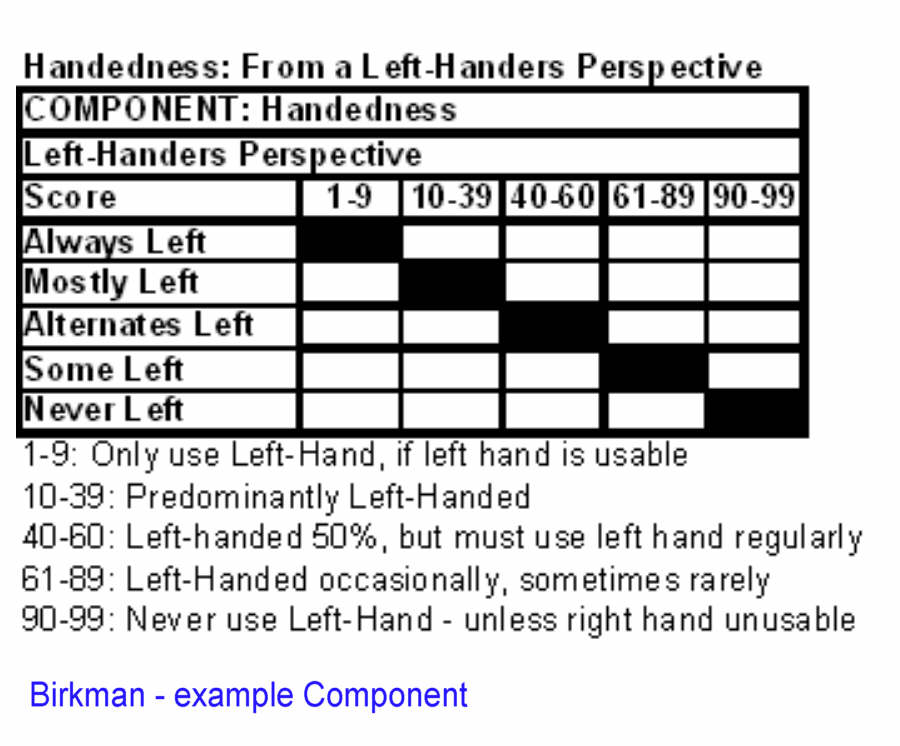
This section provides one example of the scoring of The Birkman Method®. For the purpose of explaining this approach, let's create a fictitious Component named Handedness. Low scores indicate a left-handed approach to solving dexterity problems and high scores indicate right-handed preferences. The following scale uses numbers to indicate the degree to which the left hand is preferred.
Handedness: From a Left-Hander's Perspective
Conversely, we could explain Handedness from the right-handers perspective using the same scale. If the Handedness score (or bandwidth) is between 1 and 9, the right hand is never used and, by default, the left hand is always used (unless hurt).
Handedness: From a Right-Hander's Perspective
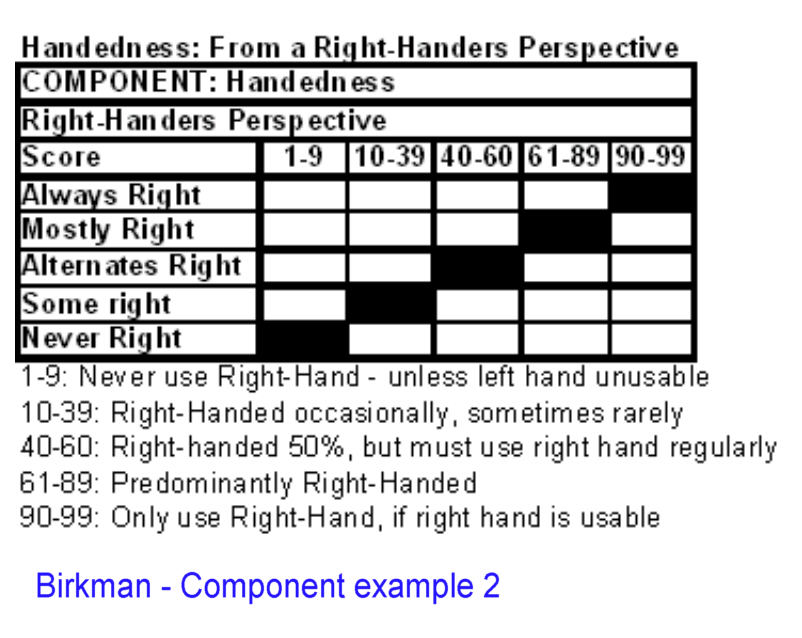
Scores of 1-9 and 90-99 are the pure forms of opposing preferences; they are differences of kind. For some individuals, the pure forms are more than 'preferences'. They are often viewed as the 'right' way. In terms of application, these 'differences of kind' can lead to one or more individuals becoming judgmental or unable to see things from the 'other' perspective. As you might suspect, the three middle bands (scores of 10-39, 40-60 and 61-89) are differences of degree, that is, they are blends of the two pure preferences.
Birkman crafted the expected Component scales so that individuals with 'low scale' values needed situations and relationships that precipitated one style of behavioral effectiveness and those who expected 'high scale' conditions that created the opposite productive style of response. Scales contained only descriptive information, no value judgment was attached to either end of any scale; therefore, both ends of the scale had equal value and positive cultural connotations. The scale values described how an individual needed to be treated or what type situation an individual prefers, not intensity or frequency of need alone.
The next section describes the aspects of each Component scale in more detail.
expectation (need) scales
Birkman found that when an individual was in a situation or relationship that proceeded in a manner that was consistent with their underlying expectations (needs) that individual felt good about self, was adaptable and exhibited positive, productive behaviors. When the relationship or situation was consistent with the individual's expectations, the individual frequently behaved in a productive manner. Birkman also found that when these expectations were not met, individuals tended to exhibit less-than-effective behaviors. This is consistent recent research in the related topic of Self-Regulation and the attending behavioral implications.
Ultimately, Birkman found that the conditions that created less-than-effective behaviors varied greatly. The only precise way for Birkman to define these 'frustrating' conditions was that they were not the expectation 'fulfillment' conditions. In other words, there were many ways to frustrate expectations but very few ways to fulfill them.
productive (usual) behavior scales
The typical, or usual, productive behaviors are expressed in a variety of situations and are readily observable by others. These scales describe an individual's effective style of dealing with relationships and tasks. These behaviors are typically described as positive or effective (although it may not mean the goals are accomplished). Low scale values are described as approaching relationships or tasks in one manner and those with a high scale value are described as approaching them in an opposite but equally effective manner.
It is easy to envision two equally skilled individuals, one excellent at motivating using intangible rewards and someone else who motivates excellently using only tangible rewards. Theoretically, this is similar to the FIRO-B Elements® assessment, which assumes that an individual's behavior is independent of their desired environmental conditions.
less-than-effective (stress) behavior scales
Scale values indicate an individual's ineffective style of dealing with relationships or tasks. These behaviors are typically described as 'how he acts when he is under stress,' or 'how she behaves when she is frustrated'. Within The Birkman Method®, this non-productive behavior might be practically productive in the short term, but costly in terms of relationships and long term effectiveness. In essence, there might be bodies along the way to achieving the objective. Individuals often report that they are not pleased with themselves after they use these 'less-than-productive' behaviors.
Again, scale values indicate the style of behavior, not level of ineffectiveness.
Note: Further insights into the causes of various less-than-productive behaviors have recently been studied by researchers within the self-regulation domain.
the birkman method® and MBTI® comparison
In 2008, CPP and Birkman International teamed together to develop the correlation tables between The Birkman Method® and the MBTI®Step II Facet Scales. For a complete comparison between both the MBTI® and MBTI® Step II, please refer to the 2008 Technical Manual for The Birkman Method®.
similarities and differences found in the study
Both The Birkman Method® and the MBTI® are non-clinical assessments. The technical manuals for both assessments have established and documented face, content, construct (convergent/divergent), and criterion-related validities. However, these two instruments have fundamentally different foundations and psychometric properties.
The MBTI® is an indicator of type. As such it does not measure the amount of a personality trait. Rather, the MBTI® sorts, or categorizes, individuals based on preference or type ('Bill prefers introversion.'), but not the strength or degree of preference ('Jane strongly prefers extraversion') nor degree of aptitude ('Harry is good at thinking'). The MBTI® is socially and environmentally independent, provides generic descriptions of productive and less-than-productive behaviors for each the sixteen possible types, and has no corresponding equivalent of the Birkman Expectations.
The Birkman Method® provides the degree of preference across eleven scales, and independently measures ten motivational factors. As well, The Birkman Method® reports on specific contextual factors which affect behavior (Expectations). Birkman reports contain thousands of productive and less-than-productive behavioral combinations and provide specific prescriptions for improving performance.
comparison between the birkman method® and the 'big five' factor model of personality
The Birkman Method® aligns with the FFM (Five Factor Model or 'Big Five' or OCEAN model), but also has sub-factors for Emotive, Social and Control Orientations. This provides additional insight into the personality and productiveness dynamics.
| FFM Constructs ('Big Five' or OCEAN model) | Birkman Orientations | Associated Birkman Components |
| Neuroticism | Emotive Orientation | Empathy, Thought, Activity |
| Extraversion | Social Orientation | Esteem, Acceptance |
| Conscientiousness | Process Orientation | Structure |
| Agreeableness | Control Orientation | Advantage, Authority |
| Openness | Change Orientation | Change |
appropriate uses for the birkman method®
The continuous trait-measurements, multi-dimensional properties, and predictive reporting provided by The Birkman Method® make it useful in decision-making and issues-based activities, such as hiring, selection, conflict resolution, personal development, leadership development, and team building.
birkman international - acknowledgements
I am grateful to Birkman International for their help in providing this summary.
For more about The Birkman Method® assessment or to purchase a copy of the 2008 Technical Manual for The Birkman Method® call(800) 215-2760 (USA) or email info@birkman.com. The 2008 Technical Manual contains the complete statistical analysis between The Birkman Method® and the MBTI® Step I and MBTI® Step II. The Technical Manual also covers the full developmental history, theoretical background, reliability and validity, empirical evidence, and norms for The Birkman Method® assessment. You may also visit the Birkman website at www.birkman.com for general information about Birkman International, Inc., The Birkman Method® assessment, and other products and services. For more about the MBTI® or MBTI® Step II or to obtain a copy of the technical manuals, visit www.cpp.com.
References/sources used in compiling the Birkman summary:
Birkman, R.W., Elizondo, Fabian, Lee, Larry G., Wadlington, Patrick L., Zamzow, Matt W. (2008). The Birkman Method® Manual. Houston, TX: Birkman International, Inc.
Birkman, R.W. (1961). Development of a personality test using social and self perception inventories. Unpublished doctoral dissertation, University of Texas, Austin.
Birkman, R.W. (1997). True Colors. Nashville, TN: Thomas Nelson, Inc.
Briggs Myers, Isabel, McCaulley, Mary H., Quenk, Naomi L., Hammer, Allen L. (1998). A Guide to the Development and Use of the Myers-Briggs Type Indicator®. Mountain View, CA: CPP, Inc.
Pittenger, David J. (1993). Measuring the MBTI And Coming Up Short. Journal of Career Planning and Employment, November, pp. 48–52.
Quenk, Naomi L., Hammer, Allen L., Majors, Mark S. (2001). MBTI Step II Manual: Exploring the Next Level of Type with the Myers-Briggs Type Indicator Form Q. Mountain View, CA: CPP, Inc.
Quenk, Naomi L. (1993). Beside ourselves: Our hidden personality in everyday life. Palo Alto, CA: CPP, Inc.
Stricker, L.J. & J. Ross. (1964). An Assessment of Some Structural Properties of the Jungian personality Typology. Journal of Abnormal and Social Psychology, Vol. 68, pp. 67-72.
other personality theories and psychometrics tests models
Review and explanation of additional personality types theories and psychometrics tests models will be added to this section in due course. If you have suggestions, or if you are a principal provider of personality testing services, psychometrics tests or personality and behavioural assessment instruments, and wish to contribute some helpful explanatory theory please get in touch.
cattell's 16PF
Here's a very brief summary.
Raymond B Cattell (1905-1998) developed his 16PF in the 1940s. Most sources indicate an original publication date of 1949, so it's been around for a while, and has gone through at least five edition revisions, which probably explains the strange letter coding sequence. The PF stands for 'Personality Factors', and there are sixteen of them, hence 16PF.
The 16PF is one of the longest-standing and most widely used personality testing systems of all. Belbin used the Cattell 16PF model in constructing his 'Belbin Team Roles' theory, model and testing instruments.
Cattell's theory asserts that every person possesses a degree of each of the following sixteen traits. Note that these traits include scale descriptions (not shown here) and terminology can vary; hence the code letters are helpful references. Cattell's 16PF personality testing instruments are available from various providers.
- Warmth (A)
- Reasoning (B)
- Emotional Stability (C)
- Dominance (E)
- Liveliness (F)
- Rule-consciousness (G)
- Social Boldness (H)
- Sensitivity (I)
- Vigilance (L)
- Abstractedness (M)
- Privateness (N)
- Apprehension/Apprehensiveness (O)
- Openness to change (Q1)
- Self-reliance (Q2)
- Perfectionism (Q3)
- Tension (Q4)
The Cattell systems also include an interpretation of the 'Big Five'factors, which the Cattell organisation refers to as 'Five Global' factors (and which mostly use different descriptive factors names).
PRISM Brain Mapping
PRISM Brain Mapping is an online neuroscience-based instrument specifically designed to identify the behavioural (US-spelling behavioral) preferences that directly relate to personal relationships and work performance. Aside from the core 'Brain Mapping' instrument, PRISM systems also embrace and offer other established profiling and HR tools.
PRISM Brain Mapping was conceived in the early 1990s for use by the medical professions in the USA to help enhance communication and rapport with patients. The creation of the tool coincided with the US national 'The Decade of the Brain' scheme, aimed at raising awareness of brain research and its benefits. The early version of the instrument attracted the attention of the business community, encouraging extensive development to meet wider commercial needs. Dr G T Viki, Senior Lecturer in Forensic Psychology at Stanford University led the development/validity studies to enhance PRISM's scales and effectiveness. Further psychological work was carried out in the UK, including preparation for the translation of the instrument into a variety of languages. PRISM is now available in English, Russian, Arabic, Chinese and Spanish, and the Indian languages, Bengali, Gujarati, Marathi and Hindi. PRISM intellectual property rights are held by a nonprofit membership organization in the USA, The Center of Applied Neuroscience, which is dedicated to advancing understanding of the brain and behaviour. The instrument is now distributed globally by PRISM Brain Mapping Technologies whose offices are located near Gatwick Airport on the outskirts of London.
The core application PRISM Brain Mapping identifies people's behaviour preferences based on brain activity. Unlike traditional psychometric instruments, PRISM approaches human behaviour from the perspective of neuroscience, rather than psychological theory.
PRISM's methodology indicates an individual's natural/instinctive behaviour preferences, and also how preferences are modified and adapted when responding to perceived demands of specific situations, notably for example, in the job role.
The PRISM organization asserts that brain complexity prevents human beings being credibly divided into a fixed number of types or groups of people, who by implication are unable to act outside of their preferences. The PRISM system therefore does not categorize people or 'score' answers in the way that many psychometric instruments tend to. Instead PRISM provides users with detailed explanation as to why they approach situations and individuals in different ways. PRISM provides three distinct profiles, or 'maps', of a person's behaviour:
- how he or she naturally prefers to behave
- the extent to which he or she feels it necessary to modify that behaviour on occasions to achieve key objectives, and
- the overall pattern of behaviour that he or she tends to use for most of the time.
Beyond this, PRISM's various systems offer a comprehensive range of behavioural preference analysis, by incorporating other established methodologies, and as such, PRISM's offering can be considered a battery or range system, in addition to containing PRISM's own unique neuroscience-based methodology.
Outputs/capabilities of PRISM profiling services include:
- profile maps showing a candidate's natural preferences, adapted preferences and consistent preferences
- Emotional Intelligence (EQ) profile
- 'Big Five' profile
- 26 point career development analysis chart
- mental toughness report
- overall profile text narrative
- candidate profile-matching to job benchmarks (notably for recruitment screening)
- 360-degree feedback process management, using in-house or generic competencies
PRISM's systems must be managed by a certified PRISM practitioner, which requires a two-day training/qualification programme/program. Thereafter practitioners have access to PRISM's seemingly extensive and flexible online systems and support.
The people at PRISM will be able to provide a lot more detail about their offerings, and I am grateful for their help in providing this brief summary. PRISM contact details:
www.prismbrainmapping.com - support@prismbrainmapping.com - +44 (0)1892 535432
OPQ
Which stands for: Occupational Personality Questionnaire.
Coming in due course...
PARIO
PARIO (oiginally named PRISM, and since changed to PARIO, to avoid confusion with a different PRISM system) is a relatively very modern personality model and psychological profiling system, developed by occupational psychologist David Sharpley in the late 1990s.
PARIO was designed to identify Individual Needs, and Patterns of Response to work demands.
PARIO was developed to address Performance at Work, and is structured somewhat differently to many traditional trait-oriented profiling systems.
PARIO draws particularly on the psychological Needs theory of Henry Murray (in turn relating to David McLelland), and George Kelly'sPersonal Construct theory (which is referenced and explained on this website in John Fisher's work), to produce a 24-scale model organised into Edgar Schien's three broad Career Anchors of:
- analytical competence - in relation to problems and problem-solving
- interpersonal competence - in relation to working with and through people
- emotional competence - in relation to tasks and taking responsibility for and achieving them
enneagram of personality types
The nine-point model developed by Gurdjieff et al during the 1900s.
Explanation coming in due course...
graphology
Graphology is the study and analysis of hand-writing. Graphology can be used to understand personality of self and others, and has been used as an aid to recruitment and selection for many years. Interestingly graphology can also be used for self-awareness and self-development, to change and improve personality traits and behaviours. See the graphology and handwriting analysis section.
using free personality tests to create interest in seminars and workshops etc
Free personality tests of various types are becoming increasingly prevalent and available on the internet. Many require the test to be completed online, which, given the increasing numbers of employees with internet-enabled laptops, makes these tests ideal for team development sessions. Other free tests can be downloaded and used manually, such as those featured on this site.
Free tests present opportunities for training and development, but care is required when using them.
Free tests can be free for various reasons, for example:
- 'lite' versions offered by serious psychometrics providers as 'teasers' or introductory tools
- tests created by various providers for different purposes and available legitimately to use and share
- (intentionally or unwittingly) unauthorised copied or 'pirated' tests which find their way onto websites or which appear to be in the 'public domain' via photocopies (unauthorised tests are obviously to be avoided since using them can incur serious liabilities)
Legitimately free-to-use tests have a place in the learning and development toolkit, but they should only be used for certain situations.
Free tests are fine for fun and for basic rough indicators, but generally (there are some exceptions) not for serious applications, nor for purposes involving sensitive situations or serious decisions, such as recruitment, career direction, counselling, or serious training and development needs analysis.
Personality tests hold a big fascination for most people - it's human nature to want to learn and discover things that we don't know about ourselves, and to have our strengths confirmed, and to have our weaknesses and vulnerabilities gently queried or explored. Tests can do all of these things - even free ones.
Personality tests can therefore introduce great interest and also stimulate lots of discussion when used in a light-hearted way in meetings, seminars and workshops, etc., but you do need to ensure that you position and explain your purpose - and the limitations of the test - carefully, so that delegates understand and feel comfortable.
People with strong (Jungian/Myers Briggs®) 'sensing' and 'thinking' personalities (engineers, adminstrators, accountants for example) will be less comfortable with vague and approximate tesst than people who have strong intuitive and empathic mindsets. Think about your type of audience before you decide on a use and an explanation. Ensure it's acceptable and suitable for the delegates.
If you ware using free personality tests 'mostly for fun', and 'just as a rough indicator' then say so. Do not position a free 'lite' test of uncertain origin and debatable scientific validity as being a reliable indicator; if you do then people will take it too seriously and you'll defeat the object - which might simply be to introduce a bit of amusement and a discussion point.
All tests - whether robust or otherwise - provide a reflection of personality of some sort, the use of which usually provokes thought, prompts discussion and possibly also invites a little self-discovery. Tests cause us to think about ourselves from a different perspective, which in itself is a liberating exercise.
Provided that the use of a test is not serious, and is positioned and explained accordingly, then it's possible to make good stimulating use of many and various free 'personality tests' that are increasingly available on the web.
Be careful to avoid unintentionally using any tests that appear free but which are actually subject to copyright and intellectual property terms of use and costs. When using free tests available on the web check that the the terms of use are appropriate for your purposes, and certainly be suspicious if anything looks too good to be true, because it might be. If in doubt seek clarification from whomever's source model or test name is referenced in the material.
There are very many free tests that can be 'positioned' for given functions (eg, management style) subject to thinking logically about how the perspective of the particular test relates to personality, style, and by implication (in this case) to management.
For example, on this website all of the free tests (such as the test based on Maslow's Hierarchy of Needs, the Multiple Intelligences test, and the VAK learning style test) can be used to indicate management style from a particular perspective. It's a matter of interpretation.
In this way, provided that your purpose is not serious (I repeat, recruitment, for example, is not to be trifled with) tests of all sorts can generally be used one way or another for most job functions, roles or aspects of work. It's a question of thinking about how a particular test relates to people's interests and/or what you are seeking to discover or indicate, be it management style, learning style, personality, aptitude, communications style, personal outlook, etc.
Thus, all tests - even the free 'lite' versions available on the web (MBTI® free versions, Enneagrams, Keirsey Temperament Sorter, etc) - can provide a useful management style perspective - or any other perspective - subject to understanding how the test criteria or model relates to whatever aspect of personality or work is being explored.
Additionally, if you want to include a personality test in a seminar or workshop, and are unsure where to start, it generally helps if you first ask your audience what they'd like to know about themselves, and if they already are aware of any particular frames of reference or personality models. And then seek and source tests accordingly, that are aimed at, or which enable, measuring those criteria, or which use the model concerned.
As with measuring anything involving the participation of a group of people, it's important to use a measurement model or set of criteria that your audience understands, otherwise the test won't mean much, on which point, different audiences more naturally relate to different models and personality theories.
By way of example, Carl Jung's 'Psychological Types' model is very applicable to management style and will commonly be readily recognised and understood by a healthcare audience or medical professionals. Having established such a 'fit' you can then set about finding a suitable Jungian test (and as already previously referenced on this page, a good free Jungian-type test is available from www.gesher.com, along with some really wonderful reference material).
Free tests are useful and helpful when used appropriately, and when they are adapted and interpreted in a way that is meaningful to the audience.
It's the same as using any other tool for any other situation: first understand the perspective - the frame of reference of the audience or user - and then select and adapt a tool to fit.
RPTministries 정태홍 목사
http://www.esesang91.com
http://twtkr.com/rptministries
http://www.facebook.com/RPTministries
독자 의견
댓글이 없습니다.