personality theories, types and tests9
firo-b®
FIRO-B® stands for Fundamental Interpersonal Relations Orientation-Behaviour.
Developed by William Schutz in 1958, Schutz first used the FIRO-B® tool to assess how teams performed in the US Navy.
The FIRO-B® is an assessment tool used to help individuals and teams better understand their preferences in satisfying three basic social needs:
- Inclusion (the degree to which one belongs to a group, team or community)
- Control (the extent to which one prefers to have structure, hierarchy and influence)
- Affection (one's preference for warmth, disclosure and intimacy).
For each of these factors, FIRO-B® assesses individuals as to:
- how much they express the needs and
- how much they want to have the needs expressed to them from others.
In this respect, FIRO-B® is measuring the three aspects ofInclusion, Control and Affection, from two 'needs perspectives' ofexpressing (outwardly directed behaviour towards others) andwanting (behaviour from others directed towards oneself).
The overall 'scores' from the assessment also reveal the degree to which people attain satisfaction from their interactions with othersversus time spent alone.
The FIRO-B® assessment data is particularly rich in enabling understanding individual and team behaviour.
As with many other personality assessments, there are no 'right or wrong', nor 'good or bad' profiles.
By reviewing the assessment information, an individual can gain insight into what kind of teams they prefer to work in, what kind of environment they'd like to work in, and what roles they prefer in the workplace.
The FIRO-B® model and assessment tool can also provide information regarding leadership styles and areas of potential conflict.
If teams take the assessment together, they can compare the extent to which each person's preferences complement or conflict with colleagues. For example, a team member wanting a high degree of inclusion would appreciate and respond well to a manager who invites him/her to various meetings. A team member with a high degree of expressed affection is likely to work well with a colleague who seeks affection and attention.
The FIRO-B® system is a simple and elegant model that particularly assists understanding of team dynamics, greater self-awareness, mutual awareness among team-members (which relates helpfully to the Johari Window model), and team leadership development.
My acknowledgements to Barbara Heyn for these introductory notes about the FIRO-B® assessment. Barbara runs Atticus Consulting LLCin Blue Ash, Ohio, and specialises in developing teams, leadership and organisations. See also Barbara Heyn's article in the love and spirituality section - about bringing compassion and humanity to work, which is obviously closely connected with understanding and respecting personality.
FIRO-B® is a trademark of the CPP, Inc (Consulting Psychologists Press).
the birkman method®
I am grateful to Birkman International Inc. for their help in providing this summary (within which the US-English spelling of 'behavior' is used because it is appropriate for the terminology and origins of the theory).
The Birkman Method® consists of ten scales describing motivations (Interests) and occupational preferences. It also has eleven scales describing 'effective behaviors' (Usual behaviors) and eleven scales describing interpersonal and environmental 'expectations' (Needs). A corresponding set of eleven derived scales describe the associated 'less than effective' (Stress) behaviors when expectations are not fulfilled. Together, these eleven scales are titled Components.
In application, The Birkman Method® provides a method of improving personal and interpersonal effectiveness, articulating issues and resolving them, and revealing hidden assumptions that directly affect interpersonal effectiveness.
The Birkman Method® notably:
assesses perceptions and situational motivators
is non-clinical, online, valid, reliable, and without 'adverse impact'
identifies 'effective,' 'less than effective' behaviors and provides practical suggestions to improve personal and interpersonal effectiveness
provides respondents with a unique problem-solving approach that can be applied to many situations, even situations beyond the extensive report options
identifies the career choices most likely to appeal to the respondent
- and is translated into 13 languages.
The core of The Birkman Method® predicts significant behavioral and motivational patterns by asking respondents about personal and social perceptions. Dr Birkman confirmed that individuals don't react to the 'real' world, but rather to their perception of it. This is the scientific response to the adage, 'perceptions are reality'.
Most researchers at the time were focused on 'why' respondents behaved the way they did. Dr Birkman was interested 'what' behaviors resulted from their perceptions. Specifically, Birkman identified work and business behaviors resulting from 'self' and 'other' perceptual responses. Ultimately, the Birkman Method® became a multifaceted, self-report tool that provides practical insights into everyday issues confronting adults as they live and work. It offers a unique way of discovering how individuals accomplish goals or miss opportunities.
origins of the theory
Roger W Birkman PhD, began his exploration of individual differences of behavior and perception while pilot and pilot instructor. His experience with the impact that misperceptions – both visual and interpersonal - had on pilot performance and student learning led him to the study of psychology. By 1950, Birkman had developed a new method of assessment called the Test of Social Comprehension. It was empirically developed from workplace interviews and observations. The instrument was designed to measure the human characteristics that he saw influence perceptions, behaviors, and motivations in normally functioning adults. Eventually, Birkman met Roy B Mefferd Jr, who was a statistician/psychometrician. Mefferd was a colleague of H J Eysenck and Mefford also worked closely Raymond Cattel, creator of the 16PF. Mefferd was the first to analyze, modify and revise The Birkman Method using factor analysis. Over the years, many more PhD psychometricians have added to the research base.
Originally, Birkman developed the scale descriptions by comparing self report item results with descriptions of likes, dislikes, and behaviors provided by third parties. Birkman then matched self-report results, item by item, with these third party behavioral descriptions. Eventually, these scales and the relationships between these scales became the working model of perceptual and interest interactions.
During the 1960s, the assessment further integrated interests and occupational measurement. This integrated assessment came to be known as The Birkman Method®. Minor modifications and improvements occurred in the following decades. In 2008, The Birkman Method was updated to current standards by combining classical test theory and item test theory to review and update the instrument. Refer to the 2008 Technical Manual for The Birkman Method® for more information.
scales used in the method
interest scales
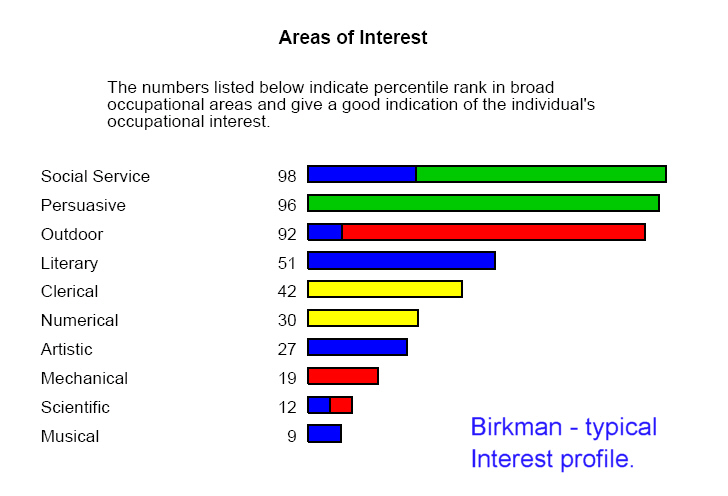
Interest scales describe an expressed motivational construct. Individuals with high scale values tend to prefer to be engaged in activities consistent with the commonly expected responsibilities of the interest scale meaning. The scales interact to form measures of general interest beyond measures of specific interest. The scale values measure intensity of desire to be involved with these activities, not skill or proficiency with these responsibilities.
The reporting style of the Interest scales ranks Interests in order of highest to lowest values. Long bars indicate a strong preference or attraction while short bars indicate minimal interest and possibly disinterest or avoidance. The following figure depicts a typical Interest profile for a respondent.
component scales
According to Birkman's research, the Components are the constructs that significantly affect normal adults in the work environment. The following is a list of the Components titles and descriptions:
acceptance
The Acceptance scales describe a sociability-based construct that addresses the manner of relating to people in groups. It includes the degree to which an individual wants to be talkative; enjoy people in groups; enjoy of social laughter; comfort in talking to strangers; enjoying parties and group activities; and approachability.
activity
The Activity scales describe a construct that addresses preferred pace of action and aspects of style, planning and decision making. This construct includes the degree to which an individual prefers action; quick thinking; and physical expression of energy.
advantage
The Advantage scales describe a construct that includes the degree to which an individual prefers to drive for personal rewards or to share in team rewards. This construct addresses the approach to idealism, and team vs. individual approaches to winning competitions and incentives. It also encompasses cautiousness about giving trust; involvement with money (as an incentive); and seeking personal advantage.
authority
The Authority scales address approaches to directing and influencing or persuading others in verbal exchanges. This construct describes the degree to which an individual wants to persuade; speak up; express opinions openly and forcefully; and/or argue.
challenge
Challenge involves the way in which a person approaches and understands the issues of socially correct behavior and especially social image. The scale addresses issues on managing social image and social expectation.
change
The Change Orientation refers to openness to new personal experiences. Individuals who score low tend to prefer repetitive effort, minimal personal disruptions, and predictable responsibilities. Individuals who score high tend to seek new experiences and explore novel approaches, even within stable environments.
empathy
The Empathy scales describe a construct the degree to which an individual is comfortable with emotional expression and involvement of feelings.
esteem
The Esteem scales describe a sensitivity-based construct that includes shyness; saying no; praising and being praised; sensitivity about correcting others or being corrected by others; getting one's feelings hurt or being embarrassed.
freedom
The Freedom scales describe a construct concerning the degree to which an individual is more conventional or unconventional in their approach to solving issues.
structure
These scales describe an orderliness-based construct that includes the degree to which an individual insists on to giving or receiving clear direction; following instructions carefully; finishing tasks; dealing with detailed tasks; working for accuracy; and using systematic approaches.
thought
The Thought scales describe a construct concerning the degree to which an individual approaches forming conclusions and making decisions; concerns for making the right decision the first time; and concerns over the consequences of those decisions.
RPTministries 정태홍 목사
http://www.esesang91.com
http://twtkr.com/rptministries
http://www.facebook.com/RPTministries
독자 의견
댓글이 없습니다.