personality theories, types and tests6
katherine benziger's personality and brain-type theory
Benziger's model is relatively recent compared to the Four Temperaments, Jung, Eysenck, etc. Her theories and tools have been widely used by many of the world's major corporations, and are still the subject of ongoing research and refinement.
Benziger's key book, The Art Of Using Your Whole Brain, was first published in 1989, revised as 'Thriving In Mind' in 2000. Benziger's main psychometrics instrument is the BTSA (Benziger Thinking Styles Assessment).
Katherine Benziger is unusual compared to many other personality thinkers (and particularly the way that other seminal theories have been developed into highly commercialised 'testing' systems) because she places greatest emphasis on 'wellness' and the need to help people avoid 'falsifying' their true type. Benziger says that very many people 'falsify type', so as to fit into a role or career path that might not be right for them, which has a negative impact on health, happiness and personal effectiveness.
Benziger drew great inspiration from Carl Jung and from the work of Myers Briggs® and Hans Eysenck. Her work has also been influenced and supported by the late 20th century scientific developments into brain imaging, using modern scanning technologies - basically using safe equivalents of X-Ray techniques - to actually determine which parts of the brain are being used for various functions and types of thinking ('thinking' here in the general sense of what the brain is doing, not in the 'logical' Jungian sense).
Put simply, Benziger's theory expresses personality in terms of four quadrants of the brain (basal means rear or back):
- Basal Left - process and routine
- Basal Right - intuition and empathy
- Front Left - logic and results
- Front Right - vision and creativity
Benziger relates these modes of thinking to Jung's Four Functions, and Benziger's theory provides many people an immensely helpful way to make sense of what Jung said and advocated. For ease of comparison between Benziger's and Jung's models the same colours are used for corresponding 'functions' or 'styles', although these colours were not part of either theorist's concepts.
Importantly Benziger acknowledges and uses the Jungian Extravertand Introvert dimension, but does not represent it within the four-quadrant model of the four functional types (Benziger's 'behaving' or 'thinking' or 'preferred' styles - the word 'thinking' is used here in a more general sense than the specific Jungian meaning).
These brain-type functions also correlate to the Myers Briggs® and Keirsey models, naturally since all of these theories make use of the fundamental Jungian 'four functional types' reference points - Thinking, Feeling, Sensing, Intuition.
| Benziger's model uses this representation of the brain (viewed from above, top is front) and the summary definitions below. The brain has four specialised areas. Each is responsible for different brain functions (which imply strengths, behaviour and thinking style). Within Benziger's model the specialised areas are called 'modes'. | 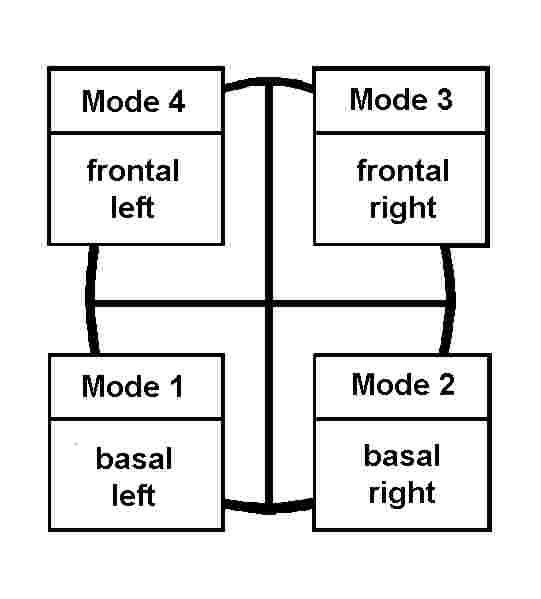 |
According to Benziger each of us possesses natural strengths in only one of these specialised areas, which causes us to favour and use a certain style ahead of others. Outside of that one style, we may have strengths and weaknesses which are based on what competencies we have been exposed to, or developed, and indeed which competencies we have not been exposed to.
Katherine Benziger refers to the natural specialised area as the 'preferred thinking and behavioural mode'. Typically this will equate to the Jungian 'superior function' and the Myers Briggs® 'dominant function' as described in this section.
Benziger's books ('The Art of Using Your Whole Brain', and in revised form 'Thriving in Mind') contain an excellent and simple personality assessment to illustrate this point. The benziger personality assessment relies on complete honesty when answering - if you are 'falsifying your type' then you will distort the analysis (which of course is true for any personality assessment or psychometrics test, although most theorists and providers seem to emphasise this aspect far less than Benziger). Incidentally the Benziger assessment also contains a section which determines the extent to which the person is falsifying type, and this for Benziger is a fundamentally important aspect of her theory and assessment methodology.
Without wishing to go off on a long tangent, Benziger's ideas about 'falsification of type' relate strongly to the need for people to seek proper 'congruence' and 'alignment' between their own true natural personal preferences, style, strengths, and the organisations and services within which they work. Organisations and employers need increasingly to wake up to these issues, both in terms of re-aligning their own values and aims so that they become more helpful for the world at large, and also in helping their people to identify and pursue and fulfil their own unique potential and destiny. Benziger's ideas are at the heart of this very modern sort of organisational philosophy.
Now back to the model. Here's how Benziger's model relates to Jung's Four Functions. Once more the colours are merely to help with comparisons to the Jung and Myers Briggs® models:
| Benziger brain quadrant | Benziger's describing characteristics examples | Jungian 'function' or 'attitude' |
| frontal left | analytical, objective, principles, standards, criteria, critiques | Thinking |
| basal left | realistic, down-to-earth, practical, sensible, the past | Sensing |
| basal right | subjective, personal, values intimacy, sees extenuating circumstances, humane, sees harmony | Feeling |
| frontal right | hunches, speculative, fantasy, imaginative, the future | Intuition |
| behaviour directed inwardly to understand and manage self and experience | Introversion | |
| behaviour directly externally, to influence outside factors and events | Extraversion |
Remember while Benziger certainly acknowledges and makes use of Jung's Extravert-Introvert dimension, it is not represented within Benziger's four-quadrants brain model.
These are Benziger's brain functions or 'modes' in more detail. Note again the correlation to the Jungian functions.
| mode | specialised area | brain functions | response to stimulus | Jungian function |
| 1 | basal left | Order and habit Ordered procedures Sequential routines | Remembers definitions. What is, is as described. | Sensing |
| 2 | basal right | Spiritual experience Rhythm and feeling Harmony | Picks up emotional tone and the presence or absence of harmony (including harmony between people). What is, is how we feel about it. | Feeling |
| 3 | frontal right | Internal imaging Metaphor and imagination Expressiveness | Sees the essence of things, in pictures and metaphors. What is, is something meaning or enabling something else. | Intuition |
| 4 | frontal left | Structural analysis Prioritising and logic Mathematics | Converts into logical results or effects. What is, leads to, or produces results. | Thinking |
Benziger says that people possess one and only one natural leading function or 'mode' in which their brain is naturally efficient.
People can and often do however develop competencies in other modes. When they do in practice they will be using more areas of their brain, and when they do this the competencies outside their natural lead are always somewhat draining, which links to Benziger's ideas about the dangers of falsification of type. If it's 'draining' using competencies that are not our natural strength, it must be more stressful still when we have to work exclusively in a competence other than our natural preference.
benziger and correlations to other personality models
Benziger's model is particularly helpful for many people in providing an excellent framework for comparing and understanding other personality models, including Jung's original four functional types, Kolb, and one or two other less well-known ideas from around the world. Once more the colours aim to help show the relationships with Jung's model, and are not part of the original theories. The correlations to the Myers Briggs® MBTI® types (and by implication Keirsey's also) are based on the functional dominance within each of these types (explained in the functional dominance sub-section of the Myers Briggs® section).
| Benziger brain mode or quadrant | Benziger (broad) types | Jung's 'Four Functional Types' | Jungian 'superior' and 'auxiliary' | Myers Briggs® MBTI® types | Keirsey types | Kolb's learning styles |
basal left | process and routine | sensing | ST and SF | ESTP ISTJ ESFP ISFJ | promoter inspector performer protector | Reflective Observation |
basal right | intuition and empathy | feeling | FS and FN | ESFJ ISFP ENFJ INFP | provider composer teacher healer | Concrete Experience |
frontal right | vision and creativity | intuition | NT and NF | ENTP INTJ ENFP INFJ | inventor mastermind champion counsellor | Active Experimentation |
frontal left | logic and results | thinking | TS and TN | ESTJ ISTP ENTJ INTP | supervisor crafter fieldmarshall architect | Abstract Conceptualisation |
More detail about Katherine Benziger's fascinating theory is on theBenziger page.
DISC
You will see the DISC model often represented as DiSC®, which reflects the ownership of this particular logoform by the US Inscape Publishing company. Inscape has extensively researched and developed its own DISC systems, which according to the company's publicity have been used by over 40 million people since the early 1970s, which are used with the intention of enabling people to "...gain the insight they need to be more successful, productive, and fulfilled at work..." Inscape also say, "... DiSC® instruments are based on a simple idea - that the foundation of personal and professional success lies in knowing yourself, understanding others, and realizing the impact of your actions and attitudes on other people..."
The DISC model is attributed to Dr William Moulton Marston, whose book Emotions Of Normal People (1928) first explained the model using the DISC terminology, and which also provided the descriptive words on which the commonly used DISC personality assessment systems were built. Marston didn't create an assessment tool. This was done initially by researchers at the University of Minnesota, in 1972 according to Inscape. Inscape, and others, have continued to develop, test and validate DISC assessment systems, which are marketed with gusto to the corporate and organisational development communities.
The dimensions of Behaviour and Situation feature strongly in Marston's ideas.
There are several slightly varying interpretations of this model. Here's a general outline.
RPTministries 정태홍 목사
http://www.esesang91.com
http://twtkr.com/rptministries
http://www.facebook.com/RPTministries
독자 의견
댓글이 없습니다.