A Biblical Evaluation of Theophostic Ministry 2
A Biblical Evaluation of Theophostic Ministry 2
by the Staff of Community Evangelical Free Church
Elverson, Pennsylvania
September 28, 2001
(자료출처 http://www.cefcelverson.org/theophostic.htm)'
칼 융의 분석심리학과 신성한 내면아이 개념을 이해하지 못하면
반기독교적이며 뉴에이지적인 심리학과 내적치유 방향성들을 알 수가 없습니다.
"내적치유와 내면아이", "내적치유와 구상화"를 꼭 읽어 보시기 바랍니다.
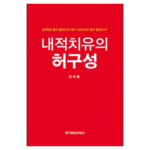
구상화를 분명하고 바르게 알기 이하여 저의 책을 참고하시기 바랍니다.


Theophostic’s focus on past traumatic events is absent in Scripture
Theophostic places strong emphasis on remembering. "Present discomfort is rooted in an unresolved historical moment." The "echo" of that moment, "the feeling you experience each time your painful memory is accessed," must be faced in order to gain authentic release (Genuine Recovery, 18). The quotes below are from the "Beyond Tolerable Recovery" basic training video series:
* "The present is a reflection of the past."
* "We need to get to the source of where it first occurred."
* "What I feel now is coming from someplace else."
* "Get to the original lie."
* "Trying to resolve present conflict without finding healing from the past wounds at best gives only temporary relief."
* "But if I heal my past I redeem my present."
The Bible, too, talks a great deal about remembering. But its focus is very different. The psalmist remembered God’s long ago miracles (77:12), his ancient laws (119:52), and his name (119:55). God told Israel to wear garments with tassels — "Then you will remember to obey all my commandments . . ." (Numbers 15:40). After forty years of wandering, he tells them, "Watch yourselves closely so that you do not forget the things your eyes have seen . . . Remember the day you stood before the Lord your God at Horeb. . ." (Deut 4:9-10). He says:
(Deu 5:15) "Remember that you were slaves in Egypt . . ."
(Deu 8:2) "Remember how the LORD your God led you all the way in the desert these forty years . . ."
(Mat 16:9) "Don't you remember the five loaves for the five thousand, and how many basketfuls you gathered?"
That is, remember all God’s goodness. But he also commands:
(Deu 24:9) "Remember what the LORD your God did to Miriam [in causing leprosy]. . ."
(Luke 17:32) "Remember Lot's wife!"
That is, remember God’s punishments on the rebellious. He says to remember the Sabbath (Exo 20:8), to remember his ways (Isa 64:5), to remember the poor (Galatians 2:10). Avoid judgment by remembering God’s commands (Jude 1:17; Rev 3:3). Having stumbled, we should remember the heights we fell from (Rev 2:5). Remember Paul’s chains (Colossians 4:18). Remember Paul’s ministry (Acts 20:31). Remember when you were without hope (Eph 2:11-12).
Remember the bad things too — past traumatic events. Remember how the Amalekites attacked you so you can act accordingly in the future (Exo 17:14). Of Israel, God predicts : "You will remember your conduct and the actions by which you have defiled yourselves, and you will loathe yourselves for all the evil you have done" (Ezk 20:43). That is, you will remember so that you learn to despise sin.
Remember so as to consider. Remember so as to restrain yourself. But not a word about remembering so that "I can confront my wound . . . face-to-face and feel its fresh fury again," in order that "the pain will lead us to the root of our trouble" (Genuine Recovery, p. 17-18). There simply are no Scriptural commands to that effect. The New Testament contains twenty-one epistles of detailed instructions for sanctification and Christian living — and one hundred and fifty psalms about the deepest matters of the heart — yet not a verse outlining anything remotely resembling Theophostic practice. Theophostic is an approach novel to the history of Christianity. For twenty centuries the Church has spread without it. Yet Theophostic casts itself as integral to effective Christian ministry.
Theophostic materials pervasively misuse Scripture by violating fundamental principles of exegesis4
Two verses in particular have been used in answer to the question, "Where in the Bible can one locate the principles or practices of Theophostic ministry?"
* "So if the Son sets you free, you will be free indeed." (John 8:36)
* "For to us a child is born, to us a son is given, and the government will be on his shoulders. And he will be called Wonderful Counselor, Mighty God, Everlasting Father, Prince of Peace." (Isa 9:6)
Let us examine these, and several other passages treated in Theophostic literature, one by one.
"So if the Son sets you free, you will be free indeed" (John 8:36).
Dr. Smith uses this verse to contrast Theophostic with counseling approaches that yield only "tolerable recovery." That is, struggling Christians who try to grasp God's Word only cognitively may be "free" in a limited sense, but they won’t experience the total freedom from painful lies — the genuine recovery — that Theophostic offers.
In the context of John 8, Jesus was debating the Pharisees. During the debate, many believed in him (verse 30). To these he said, "If you hold to my teaching, you are really my disciples. . . and the truth will set you free" (vs. 31-32). Offended, the people answered, "We are Abraham's descendants and have never been slaves of anyone. How can you say that we shall be set free?" By this they showed their misunderstanding of Jesus’ teaching that their slavery was to sin and Satan. So Jesus responded in verses 34-36:
I tell you the truth, everyone who sins is a slave to sin. Now a slave has no permanent place in the family, but a son belongs to it forever. So if the Son sets you free, you will be free indeed.
In essence he was saying, "You think you are free, but you are really slaves to sin. A slave has no permanent place in the household he serves. But I'm the Son of my Father and therefore have a permanent place in his home. If you are with me, the Son, and I set you free, you will be free indeed. Your physical relationship with Abraham guarantees you nothing. I guarantee you true freedom."
Does Jesus here use the phrase "free indeed" in contrast to the bondage of someone’s struggling under the load of painful memories? Is he alluding to a girl who, molested at a young age, cannot later shake the mistaken belief that she herself was to blame for the incest? Is he contrasting the spiritual ups and downs of a struggler undergoing traditional Christian counseling with the Christian whose transformation under a process like Theophostic "is instantaneous the moment they receive peace from Jesus," and whose "genuine recovery is permanent and maintenance free"?
No, he contrasts those "free indeed" with self-righteous unbelievers who are self-satisfied in their sins but still slaves of it. He is talking about salvation and the freedom from sin that comes with it — partial in this life, complete in heaven.
* * * *
"For to us a child is born, to us a son is given, and the government will be on his shoulders. And he will be called Wonderful Counselor . . ." (Isaiah 9:6).
Does this passage hint at, or at least set the stage for, Jesus directly speaking truth to the heart of a believer in a Theophostic manner — that is, where the "logical truth" of Scripture has proven inadequate?
First, consider the term "counselor" in the Old Testament. The term described a king’s advisor, one who held a position similar to a cabinet office in the United States today. It was generally used regarding affairs of government. During a political revolution in David’s time:
While Absalom was offering sacrifices, he also sent for Ahithophel the Gilonite, David's counselor, to come from Giloh, his hometown. And so the conspiracy gained strength, and Absalom's following kept on increasing. (2 Sam 15:12)
Ahithophel had given advice to David in matters of state; now he is conscripted by Absalom. The prophet Balaam gave King counsel as to the fortunes of his political enemies (Num 24:14). Job wishes he could sleep "with kings and counselors [that is, high officials] of the earth" (3:14). King Rehoboam listened to the counsel of his young advisors rather than his old (2 Chron 10), and so forth.
In the beginning of Isaiah 9:6 (the verse we are considering), it is prophesied that when the Messiah comes, "The government will be upon his shoulders." That is, he will bear the responsibility for it. Thus, the Old Testament commentator Leupold writes that "Wonderful Counselor" is written about the Messiah in his role as statesman. It emphasizes primarily that he will be most effective in planning, in formulating a plan for action. A great work is to be done by him, even the greatest ever attempted. He had an adequate plan, the only one ever devised that measured up to the things to be attempted. To read into this word the modern notion of a therapist, or personal ministry person, helping another through personal pain is to stretch the meaning.
* * * *
"All of us have become like one who is unclean, and all our righteous acts are like filthy rags; we all shrivel up like a leaf, and like the wind our sins sweep us away" (Isaiah 64:6).
Dr. Smith uses this verse in discussing the efforts of Christians toward personal holiness who do not have the benefit of proper ministry. Their efforts, he says, although sincere, are described by this verse in Isaiah. "Our best self-effort is like filthy rags." But does the verse even address efforts at spiritual growth and sanctification? Again, the verse is wrenched from its context. Consider the preceding verses:
Since ancient times no one has heard, no ear has perceived, no eye has seen any God besides you, who acts on behalf of those who wait for him. You come to the help of those who gladly do right, who remember your ways. But when we continued to sin against them, you were angry. How then can we be saved? All of us have become like one who is unclean, and all our righteous acts are like filthy rags; we all shrivel up like a leaf, and like the wind our sins sweep us away. No one calls on your name or strives to lay hold of you; for you have hidden your face from us and made us waste away because of our sins. (Isa 64:4-7)
Isaiah wants God to "come down" and help Israel. But Israel continues to sin, and God is angry. Isaiah describes this sinning with the words "all our righteous acts are like filthy rags" — that is, "We act good outwardly, but are unchanged in our hearts." Proof of this is found in the very next verse: "No one calls on your name or strives to lay hold of you" (verse 7). The passage is thus not criticizing the efforts of God's people to fight sin in their own flesh — it condemns the fact that they are not fighting sin at all.
This lack of sensitivity to context is not merely occasional in Theophostic literature and lectures. It is pervasive.
Theophostic does not fit Scripture’s model for Christian ministry as distilled in 2 Corinthians 10:4-5
At one point, Dr. Smith quotes 2 Corinthians 10:4-5 as illustrative of Theophostic practice: "We demolish arguments and every pretension that sets itself up against the knowledge of God, and we take captive every thought to make it obedient to Christ." Yet in reality, this passage lays out a model of Christian ministry — we might call it a distillation of much of the New Testament teaching about ministry — which is radically at odds with Theophostic principles.5
In 2 Corinthians 10, Paul begins several chapters that affirm his apostolic ministry and defend against attacks by the false apostles at Corinth who argue this way: "His letters are weighty and forceful, but in person he is unimpressive and his speaking amounts to nothing" (10:10). They argue that Paul not only lacks rhetorical flourish and sufficient acquaintance with philosophy, but he also lacks stage presence.
These men have mistaken Paul's decision not to preach "with eloquence or superior wisdom" as ignorance (1 Cor 2:1). They see his coming with "weakness and fear and much trembling" as spinelessness and lack of leadership rather than a deliberate ministry style that relied on the Holy Spirit's power and not the messenger's skills (1 Cor 2:3). They take his imitation of "the meekness and gentleness of Christ" as cowardice and impotence (2 Cor 10:1). They paint him as promising to visit Corinth and then cavalierly changing his mind, calling his change of plans "fleshly wisdom" (2 Cor 1:12-23, especially vs. 23). In fact, they say that Paul generally lives "according to the flesh" and not "in the Spirit" as they themselves do (2 Cor 10:2)!
In response, Paul admits that he does indeed "walk in the flesh" in the sense of being subject to the laws and limitations of frail mortal beings. But he insists that he does not "war according to the flesh" — that is, he doesn't conduct his ministry in the self-seeking manner of an unregenerate person (2 Cor 10:3). Make no mistake, he does wage war, constantly, and is about to wage it in his following four chapters! But he will not do it according to the flesh.
How then does he conduct warfare? What weapons does he use (for anyone who wars must have weapons)? Since he fights satanic forces that are not flesh and blood (Eph 6:12), it would be folly to fight them with weapons of the flesh. Only the armor of God will do. So rather than rely on human wisdom, stage presence, rhetoric, an entertaining speaking style, and a display of massive organization, he uses the weapons outlined in Ephesians 6 — truth, righteousness, evangelism, faith, salvation, the Word of God, and prayer. And he wields these while maintaining the character of a Christian, which includes meekness and humility, even when he must be confrontational and "not spare" rebels in the church (2 Cor 13:2). These are the weapons scorned by the world yet most feared by the powers of darkness.
In 2 Cor 10:5 Paul describes the strongholds assailed by the Christian warrior: "We demolish arguments and every pretension that sets itself up against the knowledge of God, and we take captive every thought to make it obedient to Christ." In the New International Commentary on the New Testament series, Philip E. Hughes writes, "It is noticeable that [the strongholds] belong to the realm of will and intellect. . . . for a man's inner motives are the fount of his action." So, the Greeks of Paul's day worshiped human wisdom, making the word of the cross seem like foolishness. Yet Paul's strategy against such entrenched foolishness consisted in the insistent preaching — yes, arguing — of that very message which was deemed so foolish. We quote Hughes at length regarding Paul's assault on the human mind as it rebels against God:
Hence it is that the Christian warfare is aimed at the casting down of the reasonings which are the strongholds whereby the unbelieving mind seeks to fortify itself against the truths of human depravity and divine grace, and at the casting down also of every proud bulwark raised high against the knowledge of God. This metaphor emphasizes the defiant and mutinous nature of sin: sinful man does not wish to know God; he wishes himself to be the self-sufficient centre of his universe. The knowledge of God is available to him, indeed he cannot escape from it: it is a knowledge which is constitutional to him, for he himself is God's creature, made, moreover, in the image of his Creator; it is a knowledge which the whole created order clearly and ceaselessly proclaims, witnessing as it does to the eternal power and godhead of the Creator (cf. Ps. 19:1-4; Rom. 1:19f.); and it is a knowledge livingly and graciously revealed in Christ Jesus, preserved in Holy Scripture, and presented in the preaching of the gospel (cf. 4:6). But sinful man rebels against this knowledge of God. He holds down the truth in unrighteousness. Knowing God, he refuses to glorify Him as God. His senseless heart is darkened, so that, though professing himself to be wise, he becomes a fool. In short, he exchanges the truth of and about God for a lie. It is thus that Paul analyzes the intellectual motives of unbelief in Rom. 1:18-25. And this analysis reveals, starkly and precisely, the nature of the high tower raised against the knowledge of God within which proud, unregenerate man immures himself. But unless it is cast down by the gospel of God's grace in Christ Jesus, his tower becomes his tomb.
Not only are strongholds and high towers cast down, but prisoners are taken captive in the Christian warfare. These prisoners are the thoughts — the cogitations and intentions — of man's mind, and they are led captive, every one of them, into the obedience of Christ. In this way the genuine Christian position is established. The rebellion is quelled, the truth of God prevails, and the divine sovereignty is acknowledged. . . .
Unfortunately, while the thinking of regenerate man is in principle entirely subjected to the obedience of Christ, in practice it is not always entirely so. The philosophies and sophistries of the "natural" man are frequently permitted to usurp a position of influence in the redeemed intellect. This was the case with some of the Corinthian believers who, through failure to submit their thinking consistently to the obedience of Christ, were being deceived by the specious logic of the false apostles whose teaching differed fundamentally from that delivered to them by Paul, their true and authentic apostle (cf. 11:2ff.). Paul is determined to expose the perversity of mind and will of such imposters. He earnestly desires that the members of the Corinthian church may learn what it means to bring both mind and will into complete submission to, and therefore harmony with, the mind and will of Christ.
(pp. 351-353, emphases added)
If ever there was a time for Paul to stress the need for a ministry such as Theophostic proposes, it was here. Paul is discussing how people's minds are deceived, how strongholds must be overcome. Powerful weapons are needed to free people from lies. Human weapons will not do, they must be "divinely powerful." Here is the time for Paul to say something like this:
When you encounter people who seem simply unable to embrace the truth of the Bible, you should stop telling them what you think God wants them to know. They don't need truth given through a preacher or teacher, passing it from his mind to theirs. No — such people are wounded. Most of them are spiritually hungry. The reason they are not finding help from Christian churches is because we have not given them the goods. People experience life on an experiential level, not on the level of logical truth. No one can talk them out of the lies they believe — not even memorizing Scripture can. Only Jesus can. God must speak directly to the hearts and minds of his wounded little lambs. You must help them face the pain from their past experiences, and in that pain identify the lie that insulates them from the truth. Then, resist the urge to address that lie with the truth you think they need to hear. Rather, ask Jesus to address it himself, directly to their souls.
But Paul never mentions going back into painful past memories — in this passage or anywhere else. Rather, he refers to strongholds within the mind as "pretensions" that "set themselves up against the knowledge of God" that must be "demolished," "made obedient," and "taken captive" (2 Cor 10:4-5). That is, he argues that wrong thinking flows from sin and requires surrender, for wrong thinking is simply the intellect in the service of the heart's rebellion against God.
This is what Paul is saying in 2 Thessalonians 2:9-12. There, people who believe Satan's lies are not innocents — there, Satan's counterfeit miracles "deceive" only "those who are perishing." But why are they deceived? Why do they fail to embrace the truth? Because of life's painful experiences? No, it is because "they refused to love the truth" (vs. 10). As Romans 1:18 says, "they suppress the truth."
But why would anyone suppress the truth? It is because "although they knew God," to acknowledge what they know and to believe his words would mean "glorifying him as God" and "giving thanks to him" (Rom 1:21). Paul teaches that belief in lies is a moral issue, not merely a pain-generated one. He equates "not believing the truth" with "delighting in wickedness" — (2 Thess 2:10-12). And because of this, God actually "sends them a powerful delusion so that they will believe the lie" (2 Thess 2:11). In other words, many people believe lies because God is judging their prior unbelief.
If the "normal" weapons of truth, prayer, and so forth do not overcome the embedded lies in such disobedient strongholds, Paul in 2 Corinthians 10 knows only one other step to take. It is not to investigate the painful past. Rather, he says, "we will be ready to punish every act of disobedience" (10:6).
Note that in describing the weapons that fight such strongholds of false thinking, Paul doesn't list those weapons. He assumes that the Corinthians already know what "weapons" he is talking about. This is because he writes about such weapons on virtually every page of his epistles, and he constantly models their use. These weapons are truth, righteousness, evangelism, faith, salvation, the Word of God, and prayer, wielded by a Spirit-filled Christian who maintains a Christian character in his ministry — the "normal" weapons of Christian warfare employed by every generation of the church from the beginning. Paul says that such weapons "demolish" these strongholds. They demolish them in the minds of unbelieving people whom God has determined to save — and in the minds of Christians whom God is determined to sanctify.
Several other objections to Theophostic
We mention only briefly several additional concerns:
THEOPHOSTIC INCONSISTENTLY COMPARES ITS APPROACH TO THE MINISTRY OF CHRIST
Dr. Smith writes concerning his pre-Theophostic counseling ministry: "I knew that the results I was seeing was [sic] not consistent with what I saw in the New Testament" (Genuine Recovery, p.9). His point is that Jesus affected people in radical, immediate, and lasting ways all out of proportion to what Dr. Smith’s former ministry accomplished. Yet had not Jesus promised in John 14:12 that "anyone who has faith in me . . . will do what I have been doing. He will do even greater things than these, because I am going to the Father" (John 14:12)?
Yet, in the Gospels, the "works" of Jesus included not merely spiritual and psychological restoration, but physical healings, miracles of nature, and raising of the dead. If the "spectacular" results of Jesus are the model for our ministries today, why limit what we seek to remarkable healing from psychological pain? If the Gospels require us to "be consistent with what we see in the New Testament," as Dr. Smith proposes, why be selective? Christian ministry should include not only the healing of physical illnesses, but the authoritative stopping of storms and raising of the dead.
Should not this point make us examine whether Jesus’ promise of greater works relates rather to the scope of the spread of the Gospel, or some such thing?
THEOPHOSTIC TOO FREQUENTLY - ALMOST EXCLUSIVELY - USES THE MODEL OF SEXUAL ABUSE TO VALIDATE ITS METHODOLOGY
Most people, religious and otherwise, acknowledge that any attack or abuse of a sexual nature results in problems far more difficult to overcome than most any other. Yet in setting forth an apologetic for its principles of ministering to people at large — for we are "all" wounded, it is only a question of how much — Theophostic consistently uses illustrations from those sexually abused. If Theophostic proposed a methodology solely for helping sexually abused people, the objections raised in this paper, while serious, would at least be open to greater discussion. But arguing for general ministry principles based upon a special category of problem is ill advised.
DR. SMITH DOES NOT SEEM TO INVITE CRITIQUE FROM THOSE OUTSIDE THE THEOPHOSTIC FAMILY
In advising people where they can seek Theophostic help, Dr. Smith does advise them to question the potentially ministering person in this way: "Are you under the authority and spiritual covering of a recognized ministry, church or professional organization?" He adds that "If the person is a `lone wolf,’ be careful" (Genuine Recovery, p. 2).
Such advice is Scriptural. But on page 53 of Genuine Recovery, the orientation notebook containing Theophostic’s basic principles, Dr. Smith writes:
Principle six:
Traditionalists will try to discredit the process.
When I first began to share this concept with fellow therapists, I was not received with much favor or enthusiasm. I was called a quack and a charlatan. I was told that what was happening would not last, or at best, it was post-hypnotic.
However, the results that Dr. Smith viewed proved more convincing to than the remarks of his critics.
Certainly every Christian must make theological decisions and, having made them, not return daily to re-examine his entire edifice. "Each one should be fully convinced in his own mind" (Rom 14:5). But he should be open to sincere questioning. And his process of decision-making should include substantial interaction with those who disagree, especially if one’s theology is at odds with the generally accepted views of the Christian church. We do not know the history of Dr. Smith’s interactions with others regarding the type of concerns raised in this paper. But the concerns are serious, and the materials we have seen give little indication of any serious engagement with arguments like them.
On pages 232 to 236 of his larger work, Beyond Tolerable Recovery, Dr. Smith gives a running commentary on Romans 7 and part of Romans 8 that attempts to see in that passage many of the specifics of Theophostic principles. These pages stretch interpretive principles to their maximum and beyond. Page 233 contains a small box of text with this disclaimer:
This section is an Ed Smith interpretation of Romans chapter 7, presented through the grid of Theophostic Ministry principles. I know that this smacks in the face of some of our traditional thought. Bear with me, hold to what you can, and look past what you cannot. I am in theological transition as I allow the Holy Spirit to teach me and correct me where necessary. I hope you are as well. (Emphasis ours)
Dr. Smith does not invite teaching or interaction from theologians or other counselors. Rather, he allows the Holy Spirit to teach him. With such an apparent isolation during a time of "theological transition," it is not surprising that one would come to embrace the views criticized in this paper.
Then why does it work?
We might ask, "Suppose Theophostic is shown to be in error — how do we explain that it often seems to help people?" God alone can answer this. But two suggestions follow.
First, in some cases God may indeed be helping people during their Theophostic encounters. His mercy is beyond all telling. He often rains down grace when people’s understanding is deficient, or even when they are rebelling. The woman who touched Jesus’ robe in Mark 5:25-34 did not "do it right" when she approached Jesus. Her faith was misguided — she attempted to receive healing not by a personal encounter with the Savior, but by stealing a touch of his garment, as if it were magic. Her faith was also selfish — suffering a discharge of blood, she knew that touching anyone else would render that person ceremonially unclean, and her plan was to slip off unnoticed without a word of thanks. Yet Jesus graciously healed her. Or consider when God told Moses to gather seventy of Israel’s elders to the entrance of the tabernacle so the Spirit would rest upon them and they could assist in Moses’ labors. Two of the elders, Eldad and Medad, failed to come but "remained in the camp." "Yet the Spirit rested on them" as well, and they too prophesied (Num 11:16-17, 24-26). Or consider that twice the prophet Balaam resorted to sorcery in seeking God, yet God granted him an oracle each time (Num 23).
Do any of these cases prove that the supplicants’ methods were justified? Not at all. They prove only that God sometimes responds generously to our misguided — or even sinful — approaches toward him. Many people no doubt pray sincerely during Theophostic sessions. God is at liberty to answer any of them with mercy, even while his Word demonstrates the error of their approach.
Second, in many cases people may merely be imagining that Christ speaks to them or that they receive divine help. The power of suggestion is very strong. Researchers have long noticed the "healing" effects of placebos not only on those using experimental medicines but on those administering them. In Abnormal Psychology, David Holmes describes this phenomenon in experiments with depression medication:
The effects of suggestion influence not only the participants in experiments but also raters who are evaluating the participants. For example, if a depressed person is given a treatment that the therapist thinks will help, the therapist may selectively notice improvements in the patient . . . and ignore behaviors that suggest lack of improvement (e.g., lack of activity).6
Since virtually every religion, philosophy, medicine (real or quack), counseling method, and psychic reader in history boast testimonies of those marvelously helped, we must avoid the lure of anecdotal evidence as our primary means for establishing what is true. For the Christian who seeks the best means for curing wounded souls, the only sure testimony is that of Scripture. Even with Scripture, Peter warns that "ignorant and unstable people distort" it, and Paul warns that only the Christian workman who "correctly handles the word of truth" is approved — surely implying that many Christian workmen are not.
Written by Steve Estes in cooperation with the elders at CEFC
© CEFC
Permissions: You are permitted to reproduce and distribute this material in any format provided that you do not alter the wording in any way and do not charge a fee beyond the cost of reproduction. For web posting, a link to this document on our website is preferred. Any exceptions to the above must be approved by CEFC.
Please include the following statement on any distributed copy:© CEFC. Website: cefcelverson.org
ENDNOTES
1Smith, Edward. Genuine Recovery. (Campbellsville, KY: Alathia Publishing, 1996, 2000)
2Smith, Winston. "Dichotomy or Trichotomy? How the Doctrine of Man Shapes the Treatment of Depression." The Journal of Biblical Counseling 18 (Spring 2000) : 21. Emphasis ours.
3Berkhof, Louis. Systematic Theology. (Grand Rapids: Wm. B. Eerdmans Publishing Co., 1939, 1941).
4In this section, Scripture passages under consideration are quoted in bold, italicized letters.
5We are much indebted in this section for many thoughts and even phraseology in Philip E. Hughes' outstanding commentary on 2 Corinthians in the New International Commentary on the New Testament series.
6Holmes, David. Abnormal Psychology. (Massachusetts: Allyn & Bacon, 2001), p. 113.
(자료출처 http://www.cefcelverson.org/theophostic.htm)
RPTministries 정태홍 목사
http://www.esesang91.com
http://twtkr.com/rptministries
http://www.facebook.com/RPTministries
by the Staff of Community Evangelical Free Church
Elverson, Pennsylvania
September 28, 2001
(자료출처 http://www.cefcelverson.org/theophostic.htm)'
칼 융의 분석심리학과 신성한 내면아이 개념을 이해하지 못하면
반기독교적이며 뉴에이지적인 심리학과 내적치유 방향성들을 알 수가 없습니다.
"내적치유와 내면아이", "내적치유와 구상화"를 꼭 읽어 보시기 바랍니다.
구상화를 분명하고 바르게 알기 이하여 저의 책을 참고하시기 바랍니다.
Theophostic’s focus on past traumatic events is absent in Scripture
Theophostic places strong emphasis on remembering. "Present discomfort is rooted in an unresolved historical moment." The "echo" of that moment, "the feeling you experience each time your painful memory is accessed," must be faced in order to gain authentic release (Genuine Recovery, 18). The quotes below are from the "Beyond Tolerable Recovery" basic training video series:
* "The present is a reflection of the past."
* "We need to get to the source of where it first occurred."
* "What I feel now is coming from someplace else."
* "Get to the original lie."
* "Trying to resolve present conflict without finding healing from the past wounds at best gives only temporary relief."
* "But if I heal my past I redeem my present."
The Bible, too, talks a great deal about remembering. But its focus is very different. The psalmist remembered God’s long ago miracles (77:12), his ancient laws (119:52), and his name (119:55). God told Israel to wear garments with tassels — "Then you will remember to obey all my commandments . . ." (Numbers 15:40). After forty years of wandering, he tells them, "Watch yourselves closely so that you do not forget the things your eyes have seen . . . Remember the day you stood before the Lord your God at Horeb. . ." (Deut 4:9-10). He says:
(Deu 5:15) "Remember that you were slaves in Egypt . . ."
(Deu 8:2) "Remember how the LORD your God led you all the way in the desert these forty years . . ."
(Mat 16:9) "Don't you remember the five loaves for the five thousand, and how many basketfuls you gathered?"
That is, remember all God’s goodness. But he also commands:
(Deu 24:9) "Remember what the LORD your God did to Miriam [in causing leprosy]. . ."
(Luke 17:32) "Remember Lot's wife!"
That is, remember God’s punishments on the rebellious. He says to remember the Sabbath (Exo 20:8), to remember his ways (Isa 64:5), to remember the poor (Galatians 2:10). Avoid judgment by remembering God’s commands (Jude 1:17; Rev 3:3). Having stumbled, we should remember the heights we fell from (Rev 2:5). Remember Paul’s chains (Colossians 4:18). Remember Paul’s ministry (Acts 20:31). Remember when you were without hope (Eph 2:11-12).
Remember the bad things too — past traumatic events. Remember how the Amalekites attacked you so you can act accordingly in the future (Exo 17:14). Of Israel, God predicts : "You will remember your conduct and the actions by which you have defiled yourselves, and you will loathe yourselves for all the evil you have done" (Ezk 20:43). That is, you will remember so that you learn to despise sin.
Remember so as to consider. Remember so as to restrain yourself. But not a word about remembering so that "I can confront my wound . . . face-to-face and feel its fresh fury again," in order that "the pain will lead us to the root of our trouble" (Genuine Recovery, p. 17-18). There simply are no Scriptural commands to that effect. The New Testament contains twenty-one epistles of detailed instructions for sanctification and Christian living — and one hundred and fifty psalms about the deepest matters of the heart — yet not a verse outlining anything remotely resembling Theophostic practice. Theophostic is an approach novel to the history of Christianity. For twenty centuries the Church has spread without it. Yet Theophostic casts itself as integral to effective Christian ministry.
Theophostic materials pervasively misuse Scripture by violating fundamental principles of exegesis4
Two verses in particular have been used in answer to the question, "Where in the Bible can one locate the principles or practices of Theophostic ministry?"
* "So if the Son sets you free, you will be free indeed." (John 8:36)
* "For to us a child is born, to us a son is given, and the government will be on his shoulders. And he will be called Wonderful Counselor, Mighty God, Everlasting Father, Prince of Peace." (Isa 9:6)
Let us examine these, and several other passages treated in Theophostic literature, one by one.
"So if the Son sets you free, you will be free indeed" (John 8:36).
Dr. Smith uses this verse to contrast Theophostic with counseling approaches that yield only "tolerable recovery." That is, struggling Christians who try to grasp God's Word only cognitively may be "free" in a limited sense, but they won’t experience the total freedom from painful lies — the genuine recovery — that Theophostic offers.
In the context of John 8, Jesus was debating the Pharisees. During the debate, many believed in him (verse 30). To these he said, "If you hold to my teaching, you are really my disciples. . . and the truth will set you free" (vs. 31-32). Offended, the people answered, "We are Abraham's descendants and have never been slaves of anyone. How can you say that we shall be set free?" By this they showed their misunderstanding of Jesus’ teaching that their slavery was to sin and Satan. So Jesus responded in verses 34-36:
I tell you the truth, everyone who sins is a slave to sin. Now a slave has no permanent place in the family, but a son belongs to it forever. So if the Son sets you free, you will be free indeed.
In essence he was saying, "You think you are free, but you are really slaves to sin. A slave has no permanent place in the household he serves. But I'm the Son of my Father and therefore have a permanent place in his home. If you are with me, the Son, and I set you free, you will be free indeed. Your physical relationship with Abraham guarantees you nothing. I guarantee you true freedom."
Does Jesus here use the phrase "free indeed" in contrast to the bondage of someone’s struggling under the load of painful memories? Is he alluding to a girl who, molested at a young age, cannot later shake the mistaken belief that she herself was to blame for the incest? Is he contrasting the spiritual ups and downs of a struggler undergoing traditional Christian counseling with the Christian whose transformation under a process like Theophostic "is instantaneous the moment they receive peace from Jesus," and whose "genuine recovery is permanent and maintenance free"?
No, he contrasts those "free indeed" with self-righteous unbelievers who are self-satisfied in their sins but still slaves of it. He is talking about salvation and the freedom from sin that comes with it — partial in this life, complete in heaven.
* * * *
"For to us a child is born, to us a son is given, and the government will be on his shoulders. And he will be called Wonderful Counselor . . ." (Isaiah 9:6).
Does this passage hint at, or at least set the stage for, Jesus directly speaking truth to the heart of a believer in a Theophostic manner — that is, where the "logical truth" of Scripture has proven inadequate?
First, consider the term "counselor" in the Old Testament. The term described a king’s advisor, one who held a position similar to a cabinet office in the United States today. It was generally used regarding affairs of government. During a political revolution in David’s time:
While Absalom was offering sacrifices, he also sent for Ahithophel the Gilonite, David's counselor, to come from Giloh, his hometown. And so the conspiracy gained strength, and Absalom's following kept on increasing. (2 Sam 15:12)
Ahithophel had given advice to David in matters of state; now he is conscripted by Absalom. The prophet Balaam gave King counsel as to the fortunes of his political enemies (Num 24:14). Job wishes he could sleep "with kings and counselors [that is, high officials] of the earth" (3:14). King Rehoboam listened to the counsel of his young advisors rather than his old (2 Chron 10), and so forth.
In the beginning of Isaiah 9:6 (the verse we are considering), it is prophesied that when the Messiah comes, "The government will be upon his shoulders." That is, he will bear the responsibility for it. Thus, the Old Testament commentator Leupold writes that "Wonderful Counselor" is written about the Messiah in his role as statesman. It emphasizes primarily that he will be most effective in planning, in formulating a plan for action. A great work is to be done by him, even the greatest ever attempted. He had an adequate plan, the only one ever devised that measured up to the things to be attempted. To read into this word the modern notion of a therapist, or personal ministry person, helping another through personal pain is to stretch the meaning.
* * * *
"All of us have become like one who is unclean, and all our righteous acts are like filthy rags; we all shrivel up like a leaf, and like the wind our sins sweep us away" (Isaiah 64:6).
Dr. Smith uses this verse in discussing the efforts of Christians toward personal holiness who do not have the benefit of proper ministry. Their efforts, he says, although sincere, are described by this verse in Isaiah. "Our best self-effort is like filthy rags." But does the verse even address efforts at spiritual growth and sanctification? Again, the verse is wrenched from its context. Consider the preceding verses:
Since ancient times no one has heard, no ear has perceived, no eye has seen any God besides you, who acts on behalf of those who wait for him. You come to the help of those who gladly do right, who remember your ways. But when we continued to sin against them, you were angry. How then can we be saved? All of us have become like one who is unclean, and all our righteous acts are like filthy rags; we all shrivel up like a leaf, and like the wind our sins sweep us away. No one calls on your name or strives to lay hold of you; for you have hidden your face from us and made us waste away because of our sins. (Isa 64:4-7)
Isaiah wants God to "come down" and help Israel. But Israel continues to sin, and God is angry. Isaiah describes this sinning with the words "all our righteous acts are like filthy rags" — that is, "We act good outwardly, but are unchanged in our hearts." Proof of this is found in the very next verse: "No one calls on your name or strives to lay hold of you" (verse 7). The passage is thus not criticizing the efforts of God's people to fight sin in their own flesh — it condemns the fact that they are not fighting sin at all.
This lack of sensitivity to context is not merely occasional in Theophostic literature and lectures. It is pervasive.
Theophostic does not fit Scripture’s model for Christian ministry as distilled in 2 Corinthians 10:4-5
At one point, Dr. Smith quotes 2 Corinthians 10:4-5 as illustrative of Theophostic practice: "We demolish arguments and every pretension that sets itself up against the knowledge of God, and we take captive every thought to make it obedient to Christ." Yet in reality, this passage lays out a model of Christian ministry — we might call it a distillation of much of the New Testament teaching about ministry — which is radically at odds with Theophostic principles.5
In 2 Corinthians 10, Paul begins several chapters that affirm his apostolic ministry and defend against attacks by the false apostles at Corinth who argue this way: "His letters are weighty and forceful, but in person he is unimpressive and his speaking amounts to nothing" (10:10). They argue that Paul not only lacks rhetorical flourish and sufficient acquaintance with philosophy, but he also lacks stage presence.
These men have mistaken Paul's decision not to preach "with eloquence or superior wisdom" as ignorance (1 Cor 2:1). They see his coming with "weakness and fear and much trembling" as spinelessness and lack of leadership rather than a deliberate ministry style that relied on the Holy Spirit's power and not the messenger's skills (1 Cor 2:3). They take his imitation of "the meekness and gentleness of Christ" as cowardice and impotence (2 Cor 10:1). They paint him as promising to visit Corinth and then cavalierly changing his mind, calling his change of plans "fleshly wisdom" (2 Cor 1:12-23, especially vs. 23). In fact, they say that Paul generally lives "according to the flesh" and not "in the Spirit" as they themselves do (2 Cor 10:2)!
In response, Paul admits that he does indeed "walk in the flesh" in the sense of being subject to the laws and limitations of frail mortal beings. But he insists that he does not "war according to the flesh" — that is, he doesn't conduct his ministry in the self-seeking manner of an unregenerate person (2 Cor 10:3). Make no mistake, he does wage war, constantly, and is about to wage it in his following four chapters! But he will not do it according to the flesh.
How then does he conduct warfare? What weapons does he use (for anyone who wars must have weapons)? Since he fights satanic forces that are not flesh and blood (Eph 6:12), it would be folly to fight them with weapons of the flesh. Only the armor of God will do. So rather than rely on human wisdom, stage presence, rhetoric, an entertaining speaking style, and a display of massive organization, he uses the weapons outlined in Ephesians 6 — truth, righteousness, evangelism, faith, salvation, the Word of God, and prayer. And he wields these while maintaining the character of a Christian, which includes meekness and humility, even when he must be confrontational and "not spare" rebels in the church (2 Cor 13:2). These are the weapons scorned by the world yet most feared by the powers of darkness.
In 2 Cor 10:5 Paul describes the strongholds assailed by the Christian warrior: "We demolish arguments and every pretension that sets itself up against the knowledge of God, and we take captive every thought to make it obedient to Christ." In the New International Commentary on the New Testament series, Philip E. Hughes writes, "It is noticeable that [the strongholds] belong to the realm of will and intellect. . . . for a man's inner motives are the fount of his action." So, the Greeks of Paul's day worshiped human wisdom, making the word of the cross seem like foolishness. Yet Paul's strategy against such entrenched foolishness consisted in the insistent preaching — yes, arguing — of that very message which was deemed so foolish. We quote Hughes at length regarding Paul's assault on the human mind as it rebels against God:
Hence it is that the Christian warfare is aimed at the casting down of the reasonings which are the strongholds whereby the unbelieving mind seeks to fortify itself against the truths of human depravity and divine grace, and at the casting down also of every proud bulwark raised high against the knowledge of God. This metaphor emphasizes the defiant and mutinous nature of sin: sinful man does not wish to know God; he wishes himself to be the self-sufficient centre of his universe. The knowledge of God is available to him, indeed he cannot escape from it: it is a knowledge which is constitutional to him, for he himself is God's creature, made, moreover, in the image of his Creator; it is a knowledge which the whole created order clearly and ceaselessly proclaims, witnessing as it does to the eternal power and godhead of the Creator (cf. Ps. 19:1-4; Rom. 1:19f.); and it is a knowledge livingly and graciously revealed in Christ Jesus, preserved in Holy Scripture, and presented in the preaching of the gospel (cf. 4:6). But sinful man rebels against this knowledge of God. He holds down the truth in unrighteousness. Knowing God, he refuses to glorify Him as God. His senseless heart is darkened, so that, though professing himself to be wise, he becomes a fool. In short, he exchanges the truth of and about God for a lie. It is thus that Paul analyzes the intellectual motives of unbelief in Rom. 1:18-25. And this analysis reveals, starkly and precisely, the nature of the high tower raised against the knowledge of God within which proud, unregenerate man immures himself. But unless it is cast down by the gospel of God's grace in Christ Jesus, his tower becomes his tomb.
Not only are strongholds and high towers cast down, but prisoners are taken captive in the Christian warfare. These prisoners are the thoughts — the cogitations and intentions — of man's mind, and they are led captive, every one of them, into the obedience of Christ. In this way the genuine Christian position is established. The rebellion is quelled, the truth of God prevails, and the divine sovereignty is acknowledged. . . .
Unfortunately, while the thinking of regenerate man is in principle entirely subjected to the obedience of Christ, in practice it is not always entirely so. The philosophies and sophistries of the "natural" man are frequently permitted to usurp a position of influence in the redeemed intellect. This was the case with some of the Corinthian believers who, through failure to submit their thinking consistently to the obedience of Christ, were being deceived by the specious logic of the false apostles whose teaching differed fundamentally from that delivered to them by Paul, their true and authentic apostle (cf. 11:2ff.). Paul is determined to expose the perversity of mind and will of such imposters. He earnestly desires that the members of the Corinthian church may learn what it means to bring both mind and will into complete submission to, and therefore harmony with, the mind and will of Christ.
(pp. 351-353, emphases added)
If ever there was a time for Paul to stress the need for a ministry such as Theophostic proposes, it was here. Paul is discussing how people's minds are deceived, how strongholds must be overcome. Powerful weapons are needed to free people from lies. Human weapons will not do, they must be "divinely powerful." Here is the time for Paul to say something like this:
When you encounter people who seem simply unable to embrace the truth of the Bible, you should stop telling them what you think God wants them to know. They don't need truth given through a preacher or teacher, passing it from his mind to theirs. No — such people are wounded. Most of them are spiritually hungry. The reason they are not finding help from Christian churches is because we have not given them the goods. People experience life on an experiential level, not on the level of logical truth. No one can talk them out of the lies they believe — not even memorizing Scripture can. Only Jesus can. God must speak directly to the hearts and minds of his wounded little lambs. You must help them face the pain from their past experiences, and in that pain identify the lie that insulates them from the truth. Then, resist the urge to address that lie with the truth you think they need to hear. Rather, ask Jesus to address it himself, directly to their souls.
But Paul never mentions going back into painful past memories — in this passage or anywhere else. Rather, he refers to strongholds within the mind as "pretensions" that "set themselves up against the knowledge of God" that must be "demolished," "made obedient," and "taken captive" (2 Cor 10:4-5). That is, he argues that wrong thinking flows from sin and requires surrender, for wrong thinking is simply the intellect in the service of the heart's rebellion against God.
This is what Paul is saying in 2 Thessalonians 2:9-12. There, people who believe Satan's lies are not innocents — there, Satan's counterfeit miracles "deceive" only "those who are perishing." But why are they deceived? Why do they fail to embrace the truth? Because of life's painful experiences? No, it is because "they refused to love the truth" (vs. 10). As Romans 1:18 says, "they suppress the truth."
But why would anyone suppress the truth? It is because "although they knew God," to acknowledge what they know and to believe his words would mean "glorifying him as God" and "giving thanks to him" (Rom 1:21). Paul teaches that belief in lies is a moral issue, not merely a pain-generated one. He equates "not believing the truth" with "delighting in wickedness" — (2 Thess 2:10-12). And because of this, God actually "sends them a powerful delusion so that they will believe the lie" (2 Thess 2:11). In other words, many people believe lies because God is judging their prior unbelief.
If the "normal" weapons of truth, prayer, and so forth do not overcome the embedded lies in such disobedient strongholds, Paul in 2 Corinthians 10 knows only one other step to take. It is not to investigate the painful past. Rather, he says, "we will be ready to punish every act of disobedience" (10:6).
Note that in describing the weapons that fight such strongholds of false thinking, Paul doesn't list those weapons. He assumes that the Corinthians already know what "weapons" he is talking about. This is because he writes about such weapons on virtually every page of his epistles, and he constantly models their use. These weapons are truth, righteousness, evangelism, faith, salvation, the Word of God, and prayer, wielded by a Spirit-filled Christian who maintains a Christian character in his ministry — the "normal" weapons of Christian warfare employed by every generation of the church from the beginning. Paul says that such weapons "demolish" these strongholds. They demolish them in the minds of unbelieving people whom God has determined to save — and in the minds of Christians whom God is determined to sanctify.
Several other objections to Theophostic
We mention only briefly several additional concerns:
THEOPHOSTIC INCONSISTENTLY COMPARES ITS APPROACH TO THE MINISTRY OF CHRIST
Dr. Smith writes concerning his pre-Theophostic counseling ministry: "I knew that the results I was seeing was [sic] not consistent with what I saw in the New Testament" (Genuine Recovery, p.9). His point is that Jesus affected people in radical, immediate, and lasting ways all out of proportion to what Dr. Smith’s former ministry accomplished. Yet had not Jesus promised in John 14:12 that "anyone who has faith in me . . . will do what I have been doing. He will do even greater things than these, because I am going to the Father" (John 14:12)?
Yet, in the Gospels, the "works" of Jesus included not merely spiritual and psychological restoration, but physical healings, miracles of nature, and raising of the dead. If the "spectacular" results of Jesus are the model for our ministries today, why limit what we seek to remarkable healing from psychological pain? If the Gospels require us to "be consistent with what we see in the New Testament," as Dr. Smith proposes, why be selective? Christian ministry should include not only the healing of physical illnesses, but the authoritative stopping of storms and raising of the dead.
Should not this point make us examine whether Jesus’ promise of greater works relates rather to the scope of the spread of the Gospel, or some such thing?
THEOPHOSTIC TOO FREQUENTLY - ALMOST EXCLUSIVELY - USES THE MODEL OF SEXUAL ABUSE TO VALIDATE ITS METHODOLOGY
Most people, religious and otherwise, acknowledge that any attack or abuse of a sexual nature results in problems far more difficult to overcome than most any other. Yet in setting forth an apologetic for its principles of ministering to people at large — for we are "all" wounded, it is only a question of how much — Theophostic consistently uses illustrations from those sexually abused. If Theophostic proposed a methodology solely for helping sexually abused people, the objections raised in this paper, while serious, would at least be open to greater discussion. But arguing for general ministry principles based upon a special category of problem is ill advised.
DR. SMITH DOES NOT SEEM TO INVITE CRITIQUE FROM THOSE OUTSIDE THE THEOPHOSTIC FAMILY
In advising people where they can seek Theophostic help, Dr. Smith does advise them to question the potentially ministering person in this way: "Are you under the authority and spiritual covering of a recognized ministry, church or professional organization?" He adds that "If the person is a `lone wolf,’ be careful" (Genuine Recovery, p. 2).
Such advice is Scriptural. But on page 53 of Genuine Recovery, the orientation notebook containing Theophostic’s basic principles, Dr. Smith writes:
Principle six:
Traditionalists will try to discredit the process.
When I first began to share this concept with fellow therapists, I was not received with much favor or enthusiasm. I was called a quack and a charlatan. I was told that what was happening would not last, or at best, it was post-hypnotic.
However, the results that Dr. Smith viewed proved more convincing to than the remarks of his critics.
Certainly every Christian must make theological decisions and, having made them, not return daily to re-examine his entire edifice. "Each one should be fully convinced in his own mind" (Rom 14:5). But he should be open to sincere questioning. And his process of decision-making should include substantial interaction with those who disagree, especially if one’s theology is at odds with the generally accepted views of the Christian church. We do not know the history of Dr. Smith’s interactions with others regarding the type of concerns raised in this paper. But the concerns are serious, and the materials we have seen give little indication of any serious engagement with arguments like them.
On pages 232 to 236 of his larger work, Beyond Tolerable Recovery, Dr. Smith gives a running commentary on Romans 7 and part of Romans 8 that attempts to see in that passage many of the specifics of Theophostic principles. These pages stretch interpretive principles to their maximum and beyond. Page 233 contains a small box of text with this disclaimer:
This section is an Ed Smith interpretation of Romans chapter 7, presented through the grid of Theophostic Ministry principles. I know that this smacks in the face of some of our traditional thought. Bear with me, hold to what you can, and look past what you cannot. I am in theological transition as I allow the Holy Spirit to teach me and correct me where necessary. I hope you are as well. (Emphasis ours)
Dr. Smith does not invite teaching or interaction from theologians or other counselors. Rather, he allows the Holy Spirit to teach him. With such an apparent isolation during a time of "theological transition," it is not surprising that one would come to embrace the views criticized in this paper.
Then why does it work?
We might ask, "Suppose Theophostic is shown to be in error — how do we explain that it often seems to help people?" God alone can answer this. But two suggestions follow.
First, in some cases God may indeed be helping people during their Theophostic encounters. His mercy is beyond all telling. He often rains down grace when people’s understanding is deficient, or even when they are rebelling. The woman who touched Jesus’ robe in Mark 5:25-34 did not "do it right" when she approached Jesus. Her faith was misguided — she attempted to receive healing not by a personal encounter with the Savior, but by stealing a touch of his garment, as if it were magic. Her faith was also selfish — suffering a discharge of blood, she knew that touching anyone else would render that person ceremonially unclean, and her plan was to slip off unnoticed without a word of thanks. Yet Jesus graciously healed her. Or consider when God told Moses to gather seventy of Israel’s elders to the entrance of the tabernacle so the Spirit would rest upon them and they could assist in Moses’ labors. Two of the elders, Eldad and Medad, failed to come but "remained in the camp." "Yet the Spirit rested on them" as well, and they too prophesied (Num 11:16-17, 24-26). Or consider that twice the prophet Balaam resorted to sorcery in seeking God, yet God granted him an oracle each time (Num 23).
Do any of these cases prove that the supplicants’ methods were justified? Not at all. They prove only that God sometimes responds generously to our misguided — or even sinful — approaches toward him. Many people no doubt pray sincerely during Theophostic sessions. God is at liberty to answer any of them with mercy, even while his Word demonstrates the error of their approach.
Second, in many cases people may merely be imagining that Christ speaks to them or that they receive divine help. The power of suggestion is very strong. Researchers have long noticed the "healing" effects of placebos not only on those using experimental medicines but on those administering them. In Abnormal Psychology, David Holmes describes this phenomenon in experiments with depression medication:
The effects of suggestion influence not only the participants in experiments but also raters who are evaluating the participants. For example, if a depressed person is given a treatment that the therapist thinks will help, the therapist may selectively notice improvements in the patient . . . and ignore behaviors that suggest lack of improvement (e.g., lack of activity).6
Since virtually every religion, philosophy, medicine (real or quack), counseling method, and psychic reader in history boast testimonies of those marvelously helped, we must avoid the lure of anecdotal evidence as our primary means for establishing what is true. For the Christian who seeks the best means for curing wounded souls, the only sure testimony is that of Scripture. Even with Scripture, Peter warns that "ignorant and unstable people distort" it, and Paul warns that only the Christian workman who "correctly handles the word of truth" is approved — surely implying that many Christian workmen are not.
Written by Steve Estes in cooperation with the elders at CEFC
© CEFC
Permissions: You are permitted to reproduce and distribute this material in any format provided that you do not alter the wording in any way and do not charge a fee beyond the cost of reproduction. For web posting, a link to this document on our website is preferred. Any exceptions to the above must be approved by CEFC.
Please include the following statement on any distributed copy:© CEFC. Website: cefcelverson.org
ENDNOTES
1Smith, Edward. Genuine Recovery. (Campbellsville, KY: Alathia Publishing, 1996, 2000)
2Smith, Winston. "Dichotomy or Trichotomy? How the Doctrine of Man Shapes the Treatment of Depression." The Journal of Biblical Counseling 18 (Spring 2000) : 21. Emphasis ours.
3Berkhof, Louis. Systematic Theology. (Grand Rapids: Wm. B. Eerdmans Publishing Co., 1939, 1941).
4In this section, Scripture passages under consideration are quoted in bold, italicized letters.
5We are much indebted in this section for many thoughts and even phraseology in Philip E. Hughes' outstanding commentary on 2 Corinthians in the New International Commentary on the New Testament series.
6Holmes, David. Abnormal Psychology. (Massachusetts: Allyn & Bacon, 2001), p. 113.
(자료출처 http://www.cefcelverson.org/theophostic.htm)
RPTministries 정태홍 목사
http://www.esesang91.com
http://twtkr.com/rptministries
http://www.facebook.com/RPTministries
독자 의견
댓글이 없습니다.