A Biblical Evaluation of Theophostic Ministry 1
A Biblical Evaluation of Theophostic Ministry 1
by the Staff of Community Evangelical Free Church
Elverson, Pennsylvania
September 28, 2001
(자료출처 http://www.cefcelverson.org/theophostic.htm)'
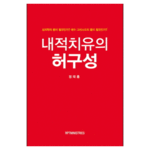
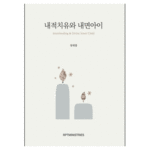
칼 융의 분석심리학과 신성한 내면아이 개념을 이해하지 못하면
반기독교적이며 뉴에이지적인 심리학과 내적치유 방향성들을 알 수가 없습니다.
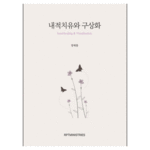
"내적치유와 내면아이", "내적치유와 구상화"를 꼭 읽어 보시기 바랍니다.
구상화를 분명하고 바르게 알기 이하여 저의 책을 참고하시기 바랍니다.
Please note: This document is also available in a more printable .PDF format here.
Table of Contents
* Introduction
* Theophostic's Pragmatic Approach to Defending its Validity
* Theophostic's Doctrine
* Theophostic presents an unscriptural view of effort in the Christian life
* Theophostic does ill justice to the sufficiency claimed by Scripture
* Theophostic displays a superficial view of sin
* Theophostic presents a distorted understanding of the doctrine of man
* Theophostic’s focus on past traumatic events is absent in Scripture
* Theophostic materials pervasively misuse Scripture by violating fundamental principles of exegesis
* Theophostic does not fit Scripture’s model for Christian ministry as distilled in 2 Corinthians 10:4-5
* Several other objections to Theophostic
* Then why does it work?
* Endnotes
"Theophostic Ministry" — from theos (God) and phos (light) — is the term coined by Dr. Ed Smith for a ministry approach that, he believes, God revealed to him following years of less-than-successful counseling of people traumatized by past events. Theophostic operates under the premise that "all of us are emotionally wounded and need our hearts and minds healed by Jesus" (Genuine Recovery, p. 1).1 Our woundedness comes from painful past experiences — not from the experiences themselves, but from lies associated with those experiences that our memories persist in believing. Much of the sin we commit stems from such lies as well.
Theophostic is a prayer ministry, "a process of divinely accomplished miracles" (p. 5). During the process, Jesus Christ speaks directly to the hearts and minds of wounded people, exposing the specific lies that bind them. When this occurs, recovery is immediate, not gradual, and permanent — that is, recovery is "genuine" as opposed to progressive. "If the Son therefore shall make you free, ye shall be free indeed" (John 8:36). This does not mean that the person is suddenly free from all of life’s issues, problems and concerns, but from the lies that bind them in that specific memory.
Theophostic Ministry has been the subject of much study, discussion and prayer by the CEFC Elder Board for nearly a year. As a result, we have concluded that we can neither actively nor passively endorse this approach to Christian ministry. Our reasoning is presented as follows. We encourage readers to carefully and prayerfully study the issues themselves.
Theophostic’s Pragmatic Approach to Defending its Validity
The primary apologetic for Theophostic Ministry is experiential. Although Dr. Smith quotes the Bible, the core argument for the ministry's validity is that Theophostic "works." Dr. Smith writes, "All I know is that the people who have experienced this healing were blind (depressed, hopeless, shamed) and now they can see!" Several further quotes:
* "I have witnessed the Spirit of God use Theophostic Ministry to accomplish this [freedom from lies and pain] hundreds of times" (Genuine Recovery, p.10).
* Regarding skeptics of Theophostic: "These people have not looked very deeply into what the Lord Jesus is doing with hurting lives throughout the world" (Genuine Recovery, p.3).
Our major concern under this point is that Scripture gives a dual criteria for testing a ministry’s legitimacy. The two criteria are "results" and "truth." Clearly it is not unbiblical to consider the results of a ministry. Jesus says, "By their fruit you will recognize them" (Matt 7:16, 20). He also says, "Believe me when I say that I am in the Father and the Father is in me; or at least believe on the evidence of the miracles themselves" (John 14:11).
But the Bible warns against evaluating someone’s ministry on the basis of results alone:
"If a prophet, or one who foretells by dreams, appears among you and announces to you a miraculous sign or wonder, {2} and if the sign or wonder of which he has spoken takes place, and he says, `Let us follow other gods' (gods you have not known) 'and let us worship them,’ {3} you must not listen to the words of that prophet or dreamer. The LORD your God is testing you to find out whether you love him with all your heart and with all your soul." (Deu 13:1-3)
Moses’ signs before Pharaoh were matched by the magicians Jannes and Jambres (2 Tim 3:8; Exo 7, 8). False prophets "will appear and perform great signs and miracles to deceive even the elect — if that were possible" (Matt 24:24). The works of the Antichrist will be "displayed in all kinds of counterfeit miracles, signs and wonders" (2 Thess 2:9). Even Paul’s ministry seemed bested by men whom he dubbed, literally, "super apostles," while his own ministry appeared "unimpressive" (2 Cor 10:10; 11:5 and elsewhere). In other words, the "super-apostles" could boast of better "results."
In the eighteenth century, Jonathan Edwards described in detail the Great-Awakening phenomenon of parishioners having intense spiritual experience, some of which later proved spurious. William James, in Varieties of Religious of Experience, collected stories from around the world of people who have been changed, sometimes drastically and for the good, by spiritual experiences that were anything but Christian. Cult meetings often include testimonies of changed lives. Regarding the Church of Scientology, David Barrett writes,
"Members say that whatever attacks are made on the movement, they believe in Dianetics and Scientology because they work" (The New Believers: Sects, ‘Cults', and Alternative Religions, p. 447).
We are not saying that Christians who use Theophostic are in a cult. We are saying that "results" are an insufficient apologetic for any ministry practice. The results of Theophostic must be tested by the doctrine of Theophostic. As we continue, we hope to show that Theophostic doctrine is in substantial error.
* * * *
Theophostic’s Doctrine
Theophostic presents an unscriptural view of effort in the Christian life
Dr. Smith criticizes approaches to ministry that urge struggling people to "go out and try again" (Genuine Recovery, p.8). Here he addresses a real weakness in much Christian care of the soul — legalistic, reductionistic methods that lack any of Christ’s supernatural life and power. Dr. Smith rightly observes that such just-try-harder approaches simply discourage people.
But Dr. Smith expands his criticisms to include all spiritual exertion — both exertion on the counselor’s part to diagnose a struggler’s problem, and exertion on the struggler’s part to overcome his problem. He likens such spiritual exertion to the works-righteousness attacked by Paul in Galatians. Dr. Smith repeatedly takes biblical passages that denounce man’s attempt to by-pass the cross and earn salvation through self-righteousness, and applies them to spiritual exertion of all kinds.
* "Our best effort is like filthy rags."
* [Dr. Smith calls his former counseling "humanistic" because it was] "based on Ed Smith's knowledge and their willingness and determination to apply it. That's nothing more than self-effort. That's a works salvation."
* "I prided myself in my ability to diagnose a person's trouble and come up with biblical steps of action. The problem with this approach is it requires the person to do something they are not able to do. This really is not any different than the Old Testament approach to keeping the law" (Genuine Recovery, p.9).
He virtually mocks the notion of self-effort in the Christian life. Genuine recovery — where all pain, fear, shame, and panic are dealt with — "is permanent and maintenance-free." During a Theophostic session, Dr. Smith doesn't "leave the memory" until the struggler reports 100% peace and calm. This healing is instantaneous the moment the person receives peace from Jesus.
* "If I have to expend energy in maintaining my pain control or behavior, then I have not truly received healing" (Genuine Recovery, p.16, emphasis ours).
* "Recovery is not building strong defenses against the lies or controlling undesirable behavior. Genuine recovery is freedom from the lies that control and dictate such behavior" (Genuine Recovery, p.10).
* "If a person is truly recovered, then relapse should not be a concern…" (Genuine Recovery, p.12).
But contrary to this perspective, Scripture continually prompts us toward Spirit-energized striving and self-control:
"Like a city whose walls are broken down is a man who lacks self-control" (Prov. 25:28).
"Above all else, guard your heart, for it is the wellspring of life" (Prov. 4:23).
"A wise man keeps himself under control" (Prov. 29:11).
"Each of you should learn to control his body in a way that is holy and honorable, not in passionate lust like the heathen" (1 Thess. 4:4).
"Prepare your minds for action; be self-controlled; set your hope fully on the grace to be given you when Jesus Christ is revealed" (1 Pet. 1:13).
"Be self-controlled and alert. Your enemy the devil prowls around like a roaring lion looking for someone to devour" (1 Pet. 5:8).
"Make every effort to add to your faith goodness; and to goodness, knowledge and to knowledge, self-control..." (2 Pet. 1:5-6).
Consider also the multiple New Testament phrases about "effort" in the Christian life. They portray the Christian life as a boxing match (1 Cor 9:26), a long-distance race (Heb 12:1), a farming of crops (2 Tim 2:6), and an infantry battle (Eph 6:11-12). They command us to "struggle" (Eph 6:12), "stand firm" (Eph 6:14), "do not let" (Rom 6:12), "do not offer" (Rom 6:13), "be careful" (1 Cor 10:12), "hold firmly" (1 Cor 15:2), "stop sinning" (1 Cor 15:34), "be on your guard" (2 Pet 3:17), "be strong" (2 Tim 2:1), "resist" (Jam 4:7), "flee" (1 Tim 6:11), "avoid" (2 Tim 2:16), "purify" (2 Cor 7:1), "watch" (1 Tim 4:16), "be diligent" (1 Tim 4:15), "be strong" (Eph 6:10), "do good" (Gal 6:9), "consider" (Rom 6:11), "persevere" (Heb 10:36), and a host of other things. This is an astounding refutation of the effortless overcoming that Dr. Smith speaks of.
In fairness, we should say that Theophostic teaching does not claim to replace the need for discipleship and spiritual growth. Hence, presumably it does not denounce the need for Spirit-empowered effort in the Christian life. No doubt Dr. Smith would not wish to quarrel with the scriptural exhortations in the above paragraph. But Theophostic teaching inadvertently drains such passages of their effect. It does so by taking an array of problems traditionally seen among Christians as "discipleship" or "growth" issues (issues that Scripture addresses and that require the effort of meditation, obedience, and so forth) and re-categorizing them as "woundedness" issues — and thus as issues that only Theophostic Ministry can address.
According to Scripture, sanctification takes work — Spirit-empowered work, we hasten to add — but work nonetheless. Theophostic Ministry, perhaps unintentionally, offers an end run around such work.
Theophostic does ill justice to the sufficiency claimed by Scripture
Theophostic literature and video lectures speak highly of Scripture and include biblical quotations. But while Scripture is professed as valued, its sufficiency is minimized. In practice, Theophostic does not view the Bible as making the man of God "thoroughly equipped for every good work" (2 Tim 3:16-17). The Bible is valuable. It is true. It is often quoted in Theophostic material. But, in practice, Theophostic cannot say that the Bible is adequate for Christian ministry.
This is seen first from the way in which Theophostic Ministry began. It was not derived from a study of the Bible. Rather, during a particularly frustrating counseling session, Dr. Smith believes God led him into using, for the first time, the principles that later came to be called Theophostic Ministry. Dr. Smith denies that he claims to be the recipient of special revelation:
"Some have suggested that I am advocating . . . new revelation. Nothing could be further from the truth. . . . There are some who are saying that I believe that I have been given a new revelation from God. I am very sorry to disappoint them, but I cannot claim such notoriety."
Rather, he says:
"I do believe that God provides His Church with new insight in new methods and applications of leading people to Jesus and into healing" (Genuine Recovery, p. 6).
That Theophostic offers new "methods" is indisputable. But that it offers new "applications" (presumably of Scripture) would be hard to establish. The proposal that Jesus Christ must directly reveal to a struggler the specific lie he is believing (not through Scripture or through bringing Scripture to mind, but directly) — that He does this only as painful memories are re-visited — and that Jesus himself must then personally refute that lie in that person’s heart, not merely in general but while the person is recalling the life context in which he began embracing that lie — these are not notions derived from a study of Scripture. They are new revelation.
That Theophostic in practice (though not in theory) sees the Bible as inadequate for ministry is seen not only in how Theophostic began, but also in the ministry principles it promotes. The quotes in the section below are from the "Beyond Tolerable Recovery" basic training videos unless noted otherwise:
* "No one, including myself, can talk me out of the lie — only Jesus can. Not even memorizing Scripture can."
* [In cautioning people to be discerning about those from whom they receive alleged Theophostic ministry, Dr. Smith says:] "They should not be giving you truth..." [He adds:] "If they are telling you what they think God wants you to know, then they are not doing Theophostic Ministry" (Genuine Recovery, p. 2).
To use Scripture with wounded people who are believing lies — and in Theophostic training materials, this means most everyone — is inadequate and thus a mistake. Dr. Smith now realizes that he "was doing Jesus' job" by trying to help people identify the lies they believe. So what do people need? "They need an experience." People need Jesus Christ to talk directly to their souls. This is not the secret work of the Holy Spirit, blowing like the wind, regenerating a person or strengthening him with power in his inner being (Ephesians 3:16). This is the second person of the Trinity, the Son of God, directly speaking extra-biblical (although not anti-biblical) content into the person’s heart.
* "Most truth is given cognitively through a teacher or preacher passing it from their mind to the recipient's mind. Theophostic Ministry is the process of God speaking directly to the hearts and minds of His wounded little lambs. True sheep still hear His voice" (Genuine Recovery, p.6).
* "Somewhere along the way the Church exchanged experiencing Jesus (faith) with learning about Jesus (cognitive)."
* "I won't do well until Jesus brings truth to my experiential side."
This difference between experiential knowledge and logical truth is "one of the most important principles of the Theophostic process" (Beyond Tolerable Recovery, p. 203). Because of this, Dr. Smith says he "no longer gives advice," which means even advice from Scripture. When we are enmeshed in a lie, the discipline of forcing our minds to meditate on "logical truth" — even that of Scripture — "doesn't do a whole lot of good."
As we have noted, Dr. Smith insists that Theophostic does not replace the need for discipleship and Christian growth. But his references to discipleship and "normal" methods of growth are sparse and lack the same enthusiasm shown for Theophostic procedures. It is clear that the real key to progress in the Christian life is to be set free from lies by a direct word from Jesus Christ — and this by way of a process that, as of this writing, was revealed to the Christian church only about three years ago, via Dr. Smith.
Theophostic displays a superficial view of sin
Dr. Smith asks the question, "What keeps us from soaring?" By this he means something like, "What keeps us from living productive, contented Christian lives?" Theophostic replies that the problem is not "a lack of truth" — for most Christians already have all the truth they can absorb. Nor is the problem a "lack of desire for more" — for "most people are spiritually hungry."
(Pausing for a moment, can we truly accept that most western Christians know the Bible’s truths well? Do they study it? Are their thought patterns permeated by it? And are "most people" — presumably, both Christians and non-Christians — truly hungry and thirsty for God, rather than for his benefits? Does not Romans 3:11 say that "there is no one . . . who seeks God"?)
Dr. Smith goes on to say where the true problem lies — it is that Christian churches and ministries "haven't given them the goods." The "goods" are the tools and perspective of Theophostic. In contrast to the "sin-based theology" of traditional Christianity, Theophostic promotes a "lie-based theology" that finds the root problem of many people, apparently most people, not in their sinfulness but in their belief of lies. Sin is real, but a belief in lies is the even deeper reality. These lies grow in the soil of pain and woundedness that we experienced in past difficult situations. Sin is not focused on in Theophostic literature. Neither is ignorance of the Bible, or a failure to hide its truths in our hearts. But the human experience of pain, and the lies bred by pain, are spotlighted and scrutinized. When sin is discussed, it is acknowledged as real and as requiring a prayer of confession during which God’s grace and pardon is claimed. But a mention of sin in Theophostic literature leads quickly into qualifiers such as, "It is important to note that not all guilt or shame is genuine. Most of the time the guilt and shame coming from childhood is false. . ." (Genuine Recovery, p. 42).
Consider this quote concerning people embroiled in perpetual arguments, marital or otherwise:
* "I find people are not really in conflict; they are just wounded, ‘bumping' into each other's wounds or lie-infested painful memories" (Genuine Recovery, p.9).
Yet how does Scripture diagnose conflict?
"What causes fights and quarrels among you? Don't they come from your desires that battle within you? You want something but don't get it. You kill and covet, but you cannot have what you want. You quarrel and fight. . . ." (James 4:1-2).
Consider these quotes from Dr. Smith:
* "If we have lies stored in our experiential knowledge we will have little choice but [to] act out accordingly or else live a life of constant struggle and self-effort." (emphasis added)
* [Regarding our "primary choices" which are made from "experiential knowledge" and not "logical truth"]: – "[People] don't have much option." (emphasis added)
Here, people entangled by spiritual lies are presented far more as victims than as sinners. But Scripture presents the belief in such lies as less than innocent. For example, 2 Thessalonians 2:9-12 discusses those who will be deceived by the counterfeit miracles of the Antichrist. Satan’s work through him "deceives" them. What are we to make of such deceit? The passages use these phrases in parallel:
"they refused to love the truth" (verse 10)
"they will believe the lie" (verse 11)
"[they] have not believed in the truth" (verse 12)
"but have delighted in wickedness" (verse 12)
Here, believing spiritual lies is called "refusing to love the truth" and "delighting in wickedness." That is, this passage views unbelief itself as sin. Why? Because we have a vested interest in not believing certain, unpleasant truths. Non-Christians don’t want to believe that they are as sinful as Scripture depicts, or that God will hold them accountable. Even Christians have an interest in disbelieving Scriptural truths.
Let us imagine a fire-fighter who tried desperately but failed to rescue his comrade from a burning building. Understandably, he is shaken. He cannot forgive himself. Let us say that years later he still cannot lose this feeling of being responsible. His feelings persist. He is "unable to believe" God’s words in the Bible that he is loved by God, that God alone controls the day of people’s birth and death, and so forth. Yet other fire-fighters have been able to recover from the same trauma. Why not this man? As with all of us, this man has heart-motives he is unaware of. "All a man's ways seem innocent to him, but motives are weighed by the LORD" (Prov 16:2). Perhaps for this fireman to embrace the fact that he wasn’t responsible for his friend’s death would mean facing the fact that he himself cannot control the world as he imagines — and perhaps control is highly important to him. Or perhaps another motive drives him. But his inability to believe God does not grow out of a vacuum. He is driven by values that are precious to him — values that are not strictly innocent. His unbelief, therefore, though understandable, is not innocent.
Consider a non-Christian’s disbelief in the Gospel. Perhaps professed Christians have mistreated and cheated him. Perhaps a minister ran off with his mother and split his family, or a drunken deacon ran over his son with a car. His pain leads him to believe that "all Christians are hypocrites" and that religion is a hoax. His unbelief is to some extent understandable. We sympathize with how these experiences make faith more difficult. But God still calls upon him to repent and believe the Gospel. His unbelief is a guilty unbelief — so guilty that if he does not turn from it, he will perish eternally. Most Christians would agree with this paragraph.
Now imagine that this unbeliever becomes converted. Imagine too that, as a Christian, he undergoes a painful experience that tempts him to believe lies — lies whispering that God does not love him, or that these trials happened simply because he is dirty. As a Christian, his unbelief is made of the "same stuff" as before his conversion. Perhaps his unbelief is quantitatively less, but qualitatively it is identical. It may be understandable, but still it is sinful.
Theophostic Ministry seems to make no account for this fact. It speaks of unbelief as if it were neutral, or as simply the natural response of a victimized person. Theophostic does grant that sin may keep a person from experiencing deliverance. It acknowledges the existence of "appropriate shame and guilt" that must be confessed and that can be forgiven by Christ’s blood. But belief in lies is not itself focused on as a sin problem. The focus is upon the suffering person’s pain and status as a victim needing the reassuring words of Christ.
This view of sin grows out of Theophostic’s view of man.
Theophostic presents a distorted understanding of the doctrine of man
Key to Dr. Smith’s approach is a strong differentiation between the human soul (which is only partially redeemed in this life) and the human spirit (which, in a Christian, is totally redeemed and righteous in this life). This leads to a trichotomistic (threefold) view of man as Body, Soul/Mind, and Spirit — a threefold view far more extreme than the more modest trichotomistic view held by many mainstream evangelicals. This is not a mere academic issue, for the unspoken but inescapable inference is this: Scripture speaks to the spirit, but the deeper human problem is in the soul, and the soul is not the Scripture's specialty. Lies nestled in the soul "cannot be dealt with logically" (translate "cannot be dealt with by biblical truth") — they must be dealt with directly by God.
THE SPIRIT
According to Theophostic teaching St. Paul was speaking of human spirit, not the human soul, when he penned 2 Corinthians 5:17. "Therefore if any man be in Christ, he is a new creature: old things are passed away; behold, all things are become new" (KJV). When someone becomes a Christian, his spirit alone is made new — but this newness is absolute and complete. There is nothing "old" still about the spirit. It is totally righteous, Theophostic teaches. Even if a Christian acts unrighteously, this does not affect his soul’s righteousness. The spirit, not the soul, is the "new man which after God is created in righteousness and true holiness" (Eph 4:24, KJV). The following quotes about the spirit are from the "Beyond Tolerable Recovery" basic video training series unless marked:
* "We are not in the process of becoming like Jesus but rather are on a journey of discovering who we are in Him."
* "We already are like Jesus; we just don't know it."
* "I am in Christ and what I was before (lost, depraved, sinful) has all passed away (in my spirit man) and all things have become new whether or not I believe it, feel it, or know it. My lies tell me I am shameful, guilty, imperfect, less than others or unacceptable. God's Word says I am redeemed, perfect, righteous and holy. Who are we going to believe?" (Beyond Tolerable Recovery, p. 204).
THE SOUL/MIND
In contrast, the soul is still in need of attention. It is the the part of a person that interacts with the outside world. It stores and processes information. It tries to make sense out of a person’s life experiences. It develops the person’s values by how it interprets those events. The soul is thus the seat of the conscience. It "rewards" or "punishes" the person according to its values, making him feel guilty or innocent. These values are "based on the mind’s current thinking," which may or may not be correct.
HOW THE SPIRIT AND SOUL INTERACT
The spirit, being totally righteous, always wants to choose the good. But when the spirit chooses to act, its options are limited by the condition of the soul (or mind) — that is, by what the mind or soul is thinking or believing. Any darkness in the mind or soul "cripples the spirit."
* "The righteous spirit desires to act righteously but is limited to the information of the soul's experiential knowledge."
* "The righteous spirit of man . . . is limited to the thinking of the soul. I can only act as far as I can think" (Beyond Tolerable Recovery, p. 205).
The problem is that the soul/mind, not being fully regenerated by Christ, may be believing lies. These lies stem from its false interpretations of past traumatic events.
* "My righteous spirit 'bumps into a lie' and is crippled. This is what Romans 7 is talking about when it says, 'It is no longer I that am doing it but rather the members of my flesh.'"
What is the answer to this dilemma? The mind (not the spirit) must be renewed. Theophostic teaching reminds us that Scripture speaks of this renewal, for Romans 12:2 commands: "Be ye transformed by the renewing of your mind." Other passages urge the same thing:
* "Receive the implanted word which is able to save (rebuild, restore, renew) your soul" (James 1:21) (from Beyond Tolerable Recovery).
* "Be made new in the attitude of your minds" (Ephesians 4:23).
* "I am completely regenerated spiritually the moment I come to Christ in repentance and faith. . . .Yet my soul/mind stays the same unless I choose to renew it" (Beyond Tolerable Recovery, p. 204).
How is the mind renewed? Through the Theophostic process. The above passages are not used to urge Christians toward study the Bible and meditation on its precepts. Rather, they are used to propel us to seek a "memory picture" of past traumatic events, re-access the emotional pain, discover the original lie, and have Jesus come and directly contradict that lie in our minds.
EVALUATION OF DR. SMITH'S VIEW OF MAN
At least two problems stand out concerning Dr. Smith’s understanding of the nature of man. First, the whole Theophostic system leans on a trichotomistic view of Scripture that is difficult to sustain exegetically. True, Hebrews 4:12 appears to differentiate between soul and spirit:
For the word of God is living and active. Sharper than any double-edged sword, it penetrates even to dividing soul and spirit, joints and marrow; it judges the thoughts and attitudes of the heart.
1 Thessalonians 5:23 also seems to point to a trichotomy:
May God himself, the God of peace, sanctify you through and through. May your whole spirit, soul and body be kept blameless at the coming of our Lord Jesus Christ.
But how do we then interpret Mark 12:30? "Love the Lord your God with all your heart and with all your soul and with all your mind and with all your strength." If we woodenly take each element of the person listed here as separate from the others, we must conclude that the mind and soul are separate entities — and both are separate from "the heart." Is this what Scripture really intends? In an excellent article on this subject, counselor Winston Smith comments: "Jesus is not proposing a four-fold view of people as heart, mind, soul, and strength, but commanding us to love God with our entire being."2
Many other biblical passages point in the same direction, interchanging these various terms, now using one, now using another. Death is described both as "giving up the soul" (Gen. 35:18; I Kings 17:21; Acts 15:26), and as "giving up the spirit" (Ps. 31:5; Luke 23:46; Acts 7:59). The dead are described as "the spirits in prison" (I Pet 3:19) and as "the souls of those who had been slain" (Rev. 6:9). The Bible sometimes designates man as "body and soul" (Matt. 6:25; 10:28) — at other times as "body and spirit" (Ecc. 12:7; I Cor. 5:3, 5).3 Many similar verses could be mentioned which are problematic to a strict threefold view of man. Yet, Theophostic Ministry places enormous weight on the absolute distinction between soul and spirit.
A second problem with Dr. Smith’s view of man is his teaching that our spirits become perfectly holy at conversion. He writes, "God's Word says I am redeemed, perfect, righteous, and holy" (Beyond Tolerable Recovery, p. 204). But in what way does Scripture call us "perfect, righteous, and holy?" Paul answers this in Romans 4:5.
"However, to the man who does not work but trusts God who justifies the wicked, his faith is credited as righteousness" (Rom 4:5). That is, Christ’s righteousness is imputed to our account. This is a righteousness "on the books," a legal declaration of "Not Guilty" — what theologians call a forensic righteousness. Our ledgers are put in the black, our debt is forgiven, even if we could righteously be put into debtors’ prison. Romans is describing our position before God, not the condition of our hearts.
From the moment of salvation, God treats the justified man as if he had lived Christ's life. To be sure, at salvation God does a work in our hearts that reflects what he does on our ledgers. He begins to make us holy inside in a way mirroring our being declared holy. We are "born again" (John 3:3). God takes from us our "heart of stone" and gives us "a heart of flesh" (Ezk 36:26). We experience "the washing of rebirth and renewal by the Holy Spirit" (Titus 3:5). But the Bible consistently stresses that, while this washing is complete with regard to our account or standing, it is incomplete with regard to our internal holiness. Hebrews 12:23 calls those who have gone to heaven "righteous ones who have been made perfect" — that is, at the cross they were declared righteous, but at death their hearts were made perfect. Jesus taught that the person who has been washed at spiritual rebirth "needs only to wash his feet" (John 13:10). That is, he has been cleansed — but he still needs to wash! This daily "washing" by confession of sin is not just for our souls, according to 2 Corinthians 7:1 — "Since we have these promises, dear friends, let us purify ourselves from everything that contaminates body and spirit, perfecting holiness out of reverence for God." Here the spirits of Christians are liable to contamination — something which Dr. Smith must totally deny.
Thus, Theophostic has similarities to Roman Catholic theology’s confusion of imputation and impartation. In contrast, Scripture presents us as perfect in God's eyes because Christ’s righteousness has been imputed, or credited, to us. This teaching has been historically known as the doctrine of Justification (by faith alone). The Protestant Reformers correctly saw this as "the doctrine on which the Church stands or falls." In contrast, Catholic doctrine defines justification as God's act of infusing or imparting grace or power into Christians enabling them to do good and thus attain merit. Theophostic’s error, while not identical, is dangerously close. We suspect that Dr. Smith’s low view of sin (discussed earlier) is related to his teaching that the spirits of Christians have been made perfectly holy.
RPTministries 정태홍 목사
http://www.esesang91.com
http://twtkr.com/rptministries
http://www.facebook.com/RPTministries
by the Staff of Community Evangelical Free Church
Elverson, Pennsylvania
September 28, 2001
(자료출처 http://www.cefcelverson.org/theophostic.htm)'
칼 융의 분석심리학과 신성한 내면아이 개념을 이해하지 못하면
반기독교적이며 뉴에이지적인 심리학과 내적치유 방향성들을 알 수가 없습니다.
"내적치유와 내면아이", "내적치유와 구상화"를 꼭 읽어 보시기 바랍니다.
구상화를 분명하고 바르게 알기 이하여 저의 책을 참고하시기 바랍니다.
Please note: This document is also available in a more printable .PDF format here.
Table of Contents
* Introduction
* Theophostic's Pragmatic Approach to Defending its Validity
* Theophostic's Doctrine
* Theophostic presents an unscriptural view of effort in the Christian life
* Theophostic does ill justice to the sufficiency claimed by Scripture
* Theophostic displays a superficial view of sin
* Theophostic presents a distorted understanding of the doctrine of man
* Theophostic’s focus on past traumatic events is absent in Scripture
* Theophostic materials pervasively misuse Scripture by violating fundamental principles of exegesis
* Theophostic does not fit Scripture’s model for Christian ministry as distilled in 2 Corinthians 10:4-5
* Several other objections to Theophostic
* Then why does it work?
* Endnotes
"Theophostic Ministry" — from theos (God) and phos (light) — is the term coined by Dr. Ed Smith for a ministry approach that, he believes, God revealed to him following years of less-than-successful counseling of people traumatized by past events. Theophostic operates under the premise that "all of us are emotionally wounded and need our hearts and minds healed by Jesus" (Genuine Recovery, p. 1).1 Our woundedness comes from painful past experiences — not from the experiences themselves, but from lies associated with those experiences that our memories persist in believing. Much of the sin we commit stems from such lies as well.
Theophostic is a prayer ministry, "a process of divinely accomplished miracles" (p. 5). During the process, Jesus Christ speaks directly to the hearts and minds of wounded people, exposing the specific lies that bind them. When this occurs, recovery is immediate, not gradual, and permanent — that is, recovery is "genuine" as opposed to progressive. "If the Son therefore shall make you free, ye shall be free indeed" (John 8:36). This does not mean that the person is suddenly free from all of life’s issues, problems and concerns, but from the lies that bind them in that specific memory.
Theophostic Ministry has been the subject of much study, discussion and prayer by the CEFC Elder Board for nearly a year. As a result, we have concluded that we can neither actively nor passively endorse this approach to Christian ministry. Our reasoning is presented as follows. We encourage readers to carefully and prayerfully study the issues themselves.
Theophostic’s Pragmatic Approach to Defending its Validity
The primary apologetic for Theophostic Ministry is experiential. Although Dr. Smith quotes the Bible, the core argument for the ministry's validity is that Theophostic "works." Dr. Smith writes, "All I know is that the people who have experienced this healing were blind (depressed, hopeless, shamed) and now they can see!" Several further quotes:
* "I have witnessed the Spirit of God use Theophostic Ministry to accomplish this [freedom from lies and pain] hundreds of times" (Genuine Recovery, p.10).
* Regarding skeptics of Theophostic: "These people have not looked very deeply into what the Lord Jesus is doing with hurting lives throughout the world" (Genuine Recovery, p.3).
Our major concern under this point is that Scripture gives a dual criteria for testing a ministry’s legitimacy. The two criteria are "results" and "truth." Clearly it is not unbiblical to consider the results of a ministry. Jesus says, "By their fruit you will recognize them" (Matt 7:16, 20). He also says, "Believe me when I say that I am in the Father and the Father is in me; or at least believe on the evidence of the miracles themselves" (John 14:11).
But the Bible warns against evaluating someone’s ministry on the basis of results alone:
"If a prophet, or one who foretells by dreams, appears among you and announces to you a miraculous sign or wonder, {2} and if the sign or wonder of which he has spoken takes place, and he says, `Let us follow other gods' (gods you have not known) 'and let us worship them,’ {3} you must not listen to the words of that prophet or dreamer. The LORD your God is testing you to find out whether you love him with all your heart and with all your soul." (Deu 13:1-3)
Moses’ signs before Pharaoh were matched by the magicians Jannes and Jambres (2 Tim 3:8; Exo 7, 8). False prophets "will appear and perform great signs and miracles to deceive even the elect — if that were possible" (Matt 24:24). The works of the Antichrist will be "displayed in all kinds of counterfeit miracles, signs and wonders" (2 Thess 2:9). Even Paul’s ministry seemed bested by men whom he dubbed, literally, "super apostles," while his own ministry appeared "unimpressive" (2 Cor 10:10; 11:5 and elsewhere). In other words, the "super-apostles" could boast of better "results."
In the eighteenth century, Jonathan Edwards described in detail the Great-Awakening phenomenon of parishioners having intense spiritual experience, some of which later proved spurious. William James, in Varieties of Religious of Experience, collected stories from around the world of people who have been changed, sometimes drastically and for the good, by spiritual experiences that were anything but Christian. Cult meetings often include testimonies of changed lives. Regarding the Church of Scientology, David Barrett writes,
"Members say that whatever attacks are made on the movement, they believe in Dianetics and Scientology because they work" (The New Believers: Sects, ‘Cults', and Alternative Religions, p. 447).
We are not saying that Christians who use Theophostic are in a cult. We are saying that "results" are an insufficient apologetic for any ministry practice. The results of Theophostic must be tested by the doctrine of Theophostic. As we continue, we hope to show that Theophostic doctrine is in substantial error.
* * * *
Theophostic’s Doctrine
Theophostic presents an unscriptural view of effort in the Christian life
Dr. Smith criticizes approaches to ministry that urge struggling people to "go out and try again" (Genuine Recovery, p.8). Here he addresses a real weakness in much Christian care of the soul — legalistic, reductionistic methods that lack any of Christ’s supernatural life and power. Dr. Smith rightly observes that such just-try-harder approaches simply discourage people.
But Dr. Smith expands his criticisms to include all spiritual exertion — both exertion on the counselor’s part to diagnose a struggler’s problem, and exertion on the struggler’s part to overcome his problem. He likens such spiritual exertion to the works-righteousness attacked by Paul in Galatians. Dr. Smith repeatedly takes biblical passages that denounce man’s attempt to by-pass the cross and earn salvation through self-righteousness, and applies them to spiritual exertion of all kinds.
* "Our best effort is like filthy rags."
* [Dr. Smith calls his former counseling "humanistic" because it was] "based on Ed Smith's knowledge and their willingness and determination to apply it. That's nothing more than self-effort. That's a works salvation."
* "I prided myself in my ability to diagnose a person's trouble and come up with biblical steps of action. The problem with this approach is it requires the person to do something they are not able to do. This really is not any different than the Old Testament approach to keeping the law" (Genuine Recovery, p.9).
He virtually mocks the notion of self-effort in the Christian life. Genuine recovery — where all pain, fear, shame, and panic are dealt with — "is permanent and maintenance-free." During a Theophostic session, Dr. Smith doesn't "leave the memory" until the struggler reports 100% peace and calm. This healing is instantaneous the moment the person receives peace from Jesus.
* "If I have to expend energy in maintaining my pain control or behavior, then I have not truly received healing" (Genuine Recovery, p.16, emphasis ours).
* "Recovery is not building strong defenses against the lies or controlling undesirable behavior. Genuine recovery is freedom from the lies that control and dictate such behavior" (Genuine Recovery, p.10).
* "If a person is truly recovered, then relapse should not be a concern…" (Genuine Recovery, p.12).
But contrary to this perspective, Scripture continually prompts us toward Spirit-energized striving and self-control:
"Like a city whose walls are broken down is a man who lacks self-control" (Prov. 25:28).
"Above all else, guard your heart, for it is the wellspring of life" (Prov. 4:23).
"A wise man keeps himself under control" (Prov. 29:11).
"Each of you should learn to control his body in a way that is holy and honorable, not in passionate lust like the heathen" (1 Thess. 4:4).
"Prepare your minds for action; be self-controlled; set your hope fully on the grace to be given you when Jesus Christ is revealed" (1 Pet. 1:13).
"Be self-controlled and alert. Your enemy the devil prowls around like a roaring lion looking for someone to devour" (1 Pet. 5:8).
"Make every effort to add to your faith goodness; and to goodness, knowledge and to knowledge, self-control..." (2 Pet. 1:5-6).
Consider also the multiple New Testament phrases about "effort" in the Christian life. They portray the Christian life as a boxing match (1 Cor 9:26), a long-distance race (Heb 12:1), a farming of crops (2 Tim 2:6), and an infantry battle (Eph 6:11-12). They command us to "struggle" (Eph 6:12), "stand firm" (Eph 6:14), "do not let" (Rom 6:12), "do not offer" (Rom 6:13), "be careful" (1 Cor 10:12), "hold firmly" (1 Cor 15:2), "stop sinning" (1 Cor 15:34), "be on your guard" (2 Pet 3:17), "be strong" (2 Tim 2:1), "resist" (Jam 4:7), "flee" (1 Tim 6:11), "avoid" (2 Tim 2:16), "purify" (2 Cor 7:1), "watch" (1 Tim 4:16), "be diligent" (1 Tim 4:15), "be strong" (Eph 6:10), "do good" (Gal 6:9), "consider" (Rom 6:11), "persevere" (Heb 10:36), and a host of other things. This is an astounding refutation of the effortless overcoming that Dr. Smith speaks of.
In fairness, we should say that Theophostic teaching does not claim to replace the need for discipleship and spiritual growth. Hence, presumably it does not denounce the need for Spirit-empowered effort in the Christian life. No doubt Dr. Smith would not wish to quarrel with the scriptural exhortations in the above paragraph. But Theophostic teaching inadvertently drains such passages of their effect. It does so by taking an array of problems traditionally seen among Christians as "discipleship" or "growth" issues (issues that Scripture addresses and that require the effort of meditation, obedience, and so forth) and re-categorizing them as "woundedness" issues — and thus as issues that only Theophostic Ministry can address.
According to Scripture, sanctification takes work — Spirit-empowered work, we hasten to add — but work nonetheless. Theophostic Ministry, perhaps unintentionally, offers an end run around such work.
Theophostic does ill justice to the sufficiency claimed by Scripture
Theophostic literature and video lectures speak highly of Scripture and include biblical quotations. But while Scripture is professed as valued, its sufficiency is minimized. In practice, Theophostic does not view the Bible as making the man of God "thoroughly equipped for every good work" (2 Tim 3:16-17). The Bible is valuable. It is true. It is often quoted in Theophostic material. But, in practice, Theophostic cannot say that the Bible is adequate for Christian ministry.
This is seen first from the way in which Theophostic Ministry began. It was not derived from a study of the Bible. Rather, during a particularly frustrating counseling session, Dr. Smith believes God led him into using, for the first time, the principles that later came to be called Theophostic Ministry. Dr. Smith denies that he claims to be the recipient of special revelation:
"Some have suggested that I am advocating . . . new revelation. Nothing could be further from the truth. . . . There are some who are saying that I believe that I have been given a new revelation from God. I am very sorry to disappoint them, but I cannot claim such notoriety."
Rather, he says:
"I do believe that God provides His Church with new insight in new methods and applications of leading people to Jesus and into healing" (Genuine Recovery, p. 6).
That Theophostic offers new "methods" is indisputable. But that it offers new "applications" (presumably of Scripture) would be hard to establish. The proposal that Jesus Christ must directly reveal to a struggler the specific lie he is believing (not through Scripture or through bringing Scripture to mind, but directly) — that He does this only as painful memories are re-visited — and that Jesus himself must then personally refute that lie in that person’s heart, not merely in general but while the person is recalling the life context in which he began embracing that lie — these are not notions derived from a study of Scripture. They are new revelation.
That Theophostic in practice (though not in theory) sees the Bible as inadequate for ministry is seen not only in how Theophostic began, but also in the ministry principles it promotes. The quotes in the section below are from the "Beyond Tolerable Recovery" basic training videos unless noted otherwise:
* "No one, including myself, can talk me out of the lie — only Jesus can. Not even memorizing Scripture can."
* [In cautioning people to be discerning about those from whom they receive alleged Theophostic ministry, Dr. Smith says:] "They should not be giving you truth..." [He adds:] "If they are telling you what they think God wants you to know, then they are not doing Theophostic Ministry" (Genuine Recovery, p. 2).
To use Scripture with wounded people who are believing lies — and in Theophostic training materials, this means most everyone — is inadequate and thus a mistake. Dr. Smith now realizes that he "was doing Jesus' job" by trying to help people identify the lies they believe. So what do people need? "They need an experience." People need Jesus Christ to talk directly to their souls. This is not the secret work of the Holy Spirit, blowing like the wind, regenerating a person or strengthening him with power in his inner being (Ephesians 3:16). This is the second person of the Trinity, the Son of God, directly speaking extra-biblical (although not anti-biblical) content into the person’s heart.
* "Most truth is given cognitively through a teacher or preacher passing it from their mind to the recipient's mind. Theophostic Ministry is the process of God speaking directly to the hearts and minds of His wounded little lambs. True sheep still hear His voice" (Genuine Recovery, p.6).
* "Somewhere along the way the Church exchanged experiencing Jesus (faith) with learning about Jesus (cognitive)."
* "I won't do well until Jesus brings truth to my experiential side."
This difference between experiential knowledge and logical truth is "one of the most important principles of the Theophostic process" (Beyond Tolerable Recovery, p. 203). Because of this, Dr. Smith says he "no longer gives advice," which means even advice from Scripture. When we are enmeshed in a lie, the discipline of forcing our minds to meditate on "logical truth" — even that of Scripture — "doesn't do a whole lot of good."
As we have noted, Dr. Smith insists that Theophostic does not replace the need for discipleship and Christian growth. But his references to discipleship and "normal" methods of growth are sparse and lack the same enthusiasm shown for Theophostic procedures. It is clear that the real key to progress in the Christian life is to be set free from lies by a direct word from Jesus Christ — and this by way of a process that, as of this writing, was revealed to the Christian church only about three years ago, via Dr. Smith.
Theophostic displays a superficial view of sin
Dr. Smith asks the question, "What keeps us from soaring?" By this he means something like, "What keeps us from living productive, contented Christian lives?" Theophostic replies that the problem is not "a lack of truth" — for most Christians already have all the truth they can absorb. Nor is the problem a "lack of desire for more" — for "most people are spiritually hungry."
(Pausing for a moment, can we truly accept that most western Christians know the Bible’s truths well? Do they study it? Are their thought patterns permeated by it? And are "most people" — presumably, both Christians and non-Christians — truly hungry and thirsty for God, rather than for his benefits? Does not Romans 3:11 say that "there is no one . . . who seeks God"?)
Dr. Smith goes on to say where the true problem lies — it is that Christian churches and ministries "haven't given them the goods." The "goods" are the tools and perspective of Theophostic. In contrast to the "sin-based theology" of traditional Christianity, Theophostic promotes a "lie-based theology" that finds the root problem of many people, apparently most people, not in their sinfulness but in their belief of lies. Sin is real, but a belief in lies is the even deeper reality. These lies grow in the soil of pain and woundedness that we experienced in past difficult situations. Sin is not focused on in Theophostic literature. Neither is ignorance of the Bible, or a failure to hide its truths in our hearts. But the human experience of pain, and the lies bred by pain, are spotlighted and scrutinized. When sin is discussed, it is acknowledged as real and as requiring a prayer of confession during which God’s grace and pardon is claimed. But a mention of sin in Theophostic literature leads quickly into qualifiers such as, "It is important to note that not all guilt or shame is genuine. Most of the time the guilt and shame coming from childhood is false. . ." (Genuine Recovery, p. 42).
Consider this quote concerning people embroiled in perpetual arguments, marital or otherwise:
* "I find people are not really in conflict; they are just wounded, ‘bumping' into each other's wounds or lie-infested painful memories" (Genuine Recovery, p.9).
Yet how does Scripture diagnose conflict?
"What causes fights and quarrels among you? Don't they come from your desires that battle within you? You want something but don't get it. You kill and covet, but you cannot have what you want. You quarrel and fight. . . ." (James 4:1-2).
Consider these quotes from Dr. Smith:
* "If we have lies stored in our experiential knowledge we will have little choice but [to] act out accordingly or else live a life of constant struggle and self-effort." (emphasis added)
* [Regarding our "primary choices" which are made from "experiential knowledge" and not "logical truth"]: – "[People] don't have much option." (emphasis added)
Here, people entangled by spiritual lies are presented far more as victims than as sinners. But Scripture presents the belief in such lies as less than innocent. For example, 2 Thessalonians 2:9-12 discusses those who will be deceived by the counterfeit miracles of the Antichrist. Satan’s work through him "deceives" them. What are we to make of such deceit? The passages use these phrases in parallel:
"they refused to love the truth" (verse 10)
"they will believe the lie" (verse 11)
"[they] have not believed in the truth" (verse 12)
"but have delighted in wickedness" (verse 12)
Here, believing spiritual lies is called "refusing to love the truth" and "delighting in wickedness." That is, this passage views unbelief itself as sin. Why? Because we have a vested interest in not believing certain, unpleasant truths. Non-Christians don’t want to believe that they are as sinful as Scripture depicts, or that God will hold them accountable. Even Christians have an interest in disbelieving Scriptural truths.
Let us imagine a fire-fighter who tried desperately but failed to rescue his comrade from a burning building. Understandably, he is shaken. He cannot forgive himself. Let us say that years later he still cannot lose this feeling of being responsible. His feelings persist. He is "unable to believe" God’s words in the Bible that he is loved by God, that God alone controls the day of people’s birth and death, and so forth. Yet other fire-fighters have been able to recover from the same trauma. Why not this man? As with all of us, this man has heart-motives he is unaware of. "All a man's ways seem innocent to him, but motives are weighed by the LORD" (Prov 16:2). Perhaps for this fireman to embrace the fact that he wasn’t responsible for his friend’s death would mean facing the fact that he himself cannot control the world as he imagines — and perhaps control is highly important to him. Or perhaps another motive drives him. But his inability to believe God does not grow out of a vacuum. He is driven by values that are precious to him — values that are not strictly innocent. His unbelief, therefore, though understandable, is not innocent.
Consider a non-Christian’s disbelief in the Gospel. Perhaps professed Christians have mistreated and cheated him. Perhaps a minister ran off with his mother and split his family, or a drunken deacon ran over his son with a car. His pain leads him to believe that "all Christians are hypocrites" and that religion is a hoax. His unbelief is to some extent understandable. We sympathize with how these experiences make faith more difficult. But God still calls upon him to repent and believe the Gospel. His unbelief is a guilty unbelief — so guilty that if he does not turn from it, he will perish eternally. Most Christians would agree with this paragraph.
Now imagine that this unbeliever becomes converted. Imagine too that, as a Christian, he undergoes a painful experience that tempts him to believe lies — lies whispering that God does not love him, or that these trials happened simply because he is dirty. As a Christian, his unbelief is made of the "same stuff" as before his conversion. Perhaps his unbelief is quantitatively less, but qualitatively it is identical. It may be understandable, but still it is sinful.
Theophostic Ministry seems to make no account for this fact. It speaks of unbelief as if it were neutral, or as simply the natural response of a victimized person. Theophostic does grant that sin may keep a person from experiencing deliverance. It acknowledges the existence of "appropriate shame and guilt" that must be confessed and that can be forgiven by Christ’s blood. But belief in lies is not itself focused on as a sin problem. The focus is upon the suffering person’s pain and status as a victim needing the reassuring words of Christ.
This view of sin grows out of Theophostic’s view of man.
Theophostic presents a distorted understanding of the doctrine of man
Key to Dr. Smith’s approach is a strong differentiation between the human soul (which is only partially redeemed in this life) and the human spirit (which, in a Christian, is totally redeemed and righteous in this life). This leads to a trichotomistic (threefold) view of man as Body, Soul/Mind, and Spirit — a threefold view far more extreme than the more modest trichotomistic view held by many mainstream evangelicals. This is not a mere academic issue, for the unspoken but inescapable inference is this: Scripture speaks to the spirit, but the deeper human problem is in the soul, and the soul is not the Scripture's specialty. Lies nestled in the soul "cannot be dealt with logically" (translate "cannot be dealt with by biblical truth") — they must be dealt with directly by God.
THE SPIRIT
According to Theophostic teaching St. Paul was speaking of human spirit, not the human soul, when he penned 2 Corinthians 5:17. "Therefore if any man be in Christ, he is a new creature: old things are passed away; behold, all things are become new" (KJV). When someone becomes a Christian, his spirit alone is made new — but this newness is absolute and complete. There is nothing "old" still about the spirit. It is totally righteous, Theophostic teaches. Even if a Christian acts unrighteously, this does not affect his soul’s righteousness. The spirit, not the soul, is the "new man which after God is created in righteousness and true holiness" (Eph 4:24, KJV). The following quotes about the spirit are from the "Beyond Tolerable Recovery" basic video training series unless marked:
* "We are not in the process of becoming like Jesus but rather are on a journey of discovering who we are in Him."
* "We already are like Jesus; we just don't know it."
* "I am in Christ and what I was before (lost, depraved, sinful) has all passed away (in my spirit man) and all things have become new whether or not I believe it, feel it, or know it. My lies tell me I am shameful, guilty, imperfect, less than others or unacceptable. God's Word says I am redeemed, perfect, righteous and holy. Who are we going to believe?" (Beyond Tolerable Recovery, p. 204).
THE SOUL/MIND
In contrast, the soul is still in need of attention. It is the the part of a person that interacts with the outside world. It stores and processes information. It tries to make sense out of a person’s life experiences. It develops the person’s values by how it interprets those events. The soul is thus the seat of the conscience. It "rewards" or "punishes" the person according to its values, making him feel guilty or innocent. These values are "based on the mind’s current thinking," which may or may not be correct.
HOW THE SPIRIT AND SOUL INTERACT
The spirit, being totally righteous, always wants to choose the good. But when the spirit chooses to act, its options are limited by the condition of the soul (or mind) — that is, by what the mind or soul is thinking or believing. Any darkness in the mind or soul "cripples the spirit."
* "The righteous spirit desires to act righteously but is limited to the information of the soul's experiential knowledge."
* "The righteous spirit of man . . . is limited to the thinking of the soul. I can only act as far as I can think" (Beyond Tolerable Recovery, p. 205).
The problem is that the soul/mind, not being fully regenerated by Christ, may be believing lies. These lies stem from its false interpretations of past traumatic events.
* "My righteous spirit 'bumps into a lie' and is crippled. This is what Romans 7 is talking about when it says, 'It is no longer I that am doing it but rather the members of my flesh.'"
What is the answer to this dilemma? The mind (not the spirit) must be renewed. Theophostic teaching reminds us that Scripture speaks of this renewal, for Romans 12:2 commands: "Be ye transformed by the renewing of your mind." Other passages urge the same thing:
* "Receive the implanted word which is able to save (rebuild, restore, renew) your soul" (James 1:21) (from Beyond Tolerable Recovery).
* "Be made new in the attitude of your minds" (Ephesians 4:23).
* "I am completely regenerated spiritually the moment I come to Christ in repentance and faith. . . .Yet my soul/mind stays the same unless I choose to renew it" (Beyond Tolerable Recovery, p. 204).
How is the mind renewed? Through the Theophostic process. The above passages are not used to urge Christians toward study the Bible and meditation on its precepts. Rather, they are used to propel us to seek a "memory picture" of past traumatic events, re-access the emotional pain, discover the original lie, and have Jesus come and directly contradict that lie in our minds.
EVALUATION OF DR. SMITH'S VIEW OF MAN
At least two problems stand out concerning Dr. Smith’s understanding of the nature of man. First, the whole Theophostic system leans on a trichotomistic view of Scripture that is difficult to sustain exegetically. True, Hebrews 4:12 appears to differentiate between soul and spirit:
For the word of God is living and active. Sharper than any double-edged sword, it penetrates even to dividing soul and spirit, joints and marrow; it judges the thoughts and attitudes of the heart.
1 Thessalonians 5:23 also seems to point to a trichotomy:
May God himself, the God of peace, sanctify you through and through. May your whole spirit, soul and body be kept blameless at the coming of our Lord Jesus Christ.
But how do we then interpret Mark 12:30? "Love the Lord your God with all your heart and with all your soul and with all your mind and with all your strength." If we woodenly take each element of the person listed here as separate from the others, we must conclude that the mind and soul are separate entities — and both are separate from "the heart." Is this what Scripture really intends? In an excellent article on this subject, counselor Winston Smith comments: "Jesus is not proposing a four-fold view of people as heart, mind, soul, and strength, but commanding us to love God with our entire being."2
Many other biblical passages point in the same direction, interchanging these various terms, now using one, now using another. Death is described both as "giving up the soul" (Gen. 35:18; I Kings 17:21; Acts 15:26), and as "giving up the spirit" (Ps. 31:5; Luke 23:46; Acts 7:59). The dead are described as "the spirits in prison" (I Pet 3:19) and as "the souls of those who had been slain" (Rev. 6:9). The Bible sometimes designates man as "body and soul" (Matt. 6:25; 10:28) — at other times as "body and spirit" (Ecc. 12:7; I Cor. 5:3, 5).3 Many similar verses could be mentioned which are problematic to a strict threefold view of man. Yet, Theophostic Ministry places enormous weight on the absolute distinction between soul and spirit.
A second problem with Dr. Smith’s view of man is his teaching that our spirits become perfectly holy at conversion. He writes, "God's Word says I am redeemed, perfect, righteous, and holy" (Beyond Tolerable Recovery, p. 204). But in what way does Scripture call us "perfect, righteous, and holy?" Paul answers this in Romans 4:5.
"However, to the man who does not work but trusts God who justifies the wicked, his faith is credited as righteousness" (Rom 4:5). That is, Christ’s righteousness is imputed to our account. This is a righteousness "on the books," a legal declaration of "Not Guilty" — what theologians call a forensic righteousness. Our ledgers are put in the black, our debt is forgiven, even if we could righteously be put into debtors’ prison. Romans is describing our position before God, not the condition of our hearts.
From the moment of salvation, God treats the justified man as if he had lived Christ's life. To be sure, at salvation God does a work in our hearts that reflects what he does on our ledgers. He begins to make us holy inside in a way mirroring our being declared holy. We are "born again" (John 3:3). God takes from us our "heart of stone" and gives us "a heart of flesh" (Ezk 36:26). We experience "the washing of rebirth and renewal by the Holy Spirit" (Titus 3:5). But the Bible consistently stresses that, while this washing is complete with regard to our account or standing, it is incomplete with regard to our internal holiness. Hebrews 12:23 calls those who have gone to heaven "righteous ones who have been made perfect" — that is, at the cross they were declared righteous, but at death their hearts were made perfect. Jesus taught that the person who has been washed at spiritual rebirth "needs only to wash his feet" (John 13:10). That is, he has been cleansed — but he still needs to wash! This daily "washing" by confession of sin is not just for our souls, according to 2 Corinthians 7:1 — "Since we have these promises, dear friends, let us purify ourselves from everything that contaminates body and spirit, perfecting holiness out of reverence for God." Here the spirits of Christians are liable to contamination — something which Dr. Smith must totally deny.
Thus, Theophostic has similarities to Roman Catholic theology’s confusion of imputation and impartation. In contrast, Scripture presents us as perfect in God's eyes because Christ’s righteousness has been imputed, or credited, to us. This teaching has been historically known as the doctrine of Justification (by faith alone). The Protestant Reformers correctly saw this as "the doctrine on which the Church stands or falls." In contrast, Catholic doctrine defines justification as God's act of infusing or imparting grace or power into Christians enabling them to do good and thus attain merit. Theophostic’s error, while not identical, is dangerously close. We suspect that Dr. Smith’s low view of sin (discussed earlier) is related to his teaching that the spirits of Christians have been made perfectly holy.
RPTministries 정태홍 목사
http://www.esesang91.com
http://twtkr.com/rptministries
http://www.facebook.com/RPTministries
독자 의견
댓글이 없습니다.