데릭 브릴랜드의 NT 라이트 , 새로운 관점 , 바울에 대한 새로운 관점
저는 NT 라이트의 『바울과 하나님의 신실하심』을 읽으면서 블로그에 글을 쓰고 있습니다 . 교회에서 가르치는 수업의 일환으로 책의 개요를 작성하고 있는 중입니다. 이번 글은 9부작 시리즈의 여덟 번째 글입니다. 괄호 안에 숫자가 있는 인용문은 모두 책에서 발췌한 것입니다. 이전 글은 여기에서 확인하세요: 1부 | 2부 | 3부 | 4부 | 5부 | 6부 | 7부
제8부: 종말론과 로마서 9-11장
바울과 하나님의 신실하심 , 제11장 6.4-7절
I. 난해한 영역에 접근하기
“로마서 9-11장은 그 규모와 범위, 방대한 참고 문헌, 논쟁적인 신학적 및 정치적 주제, 그리고 한편으로는 사상의 전체적인 흐름에 대한 거대하고 어려운 문제, 다른 한편으로는 복잡한 주해와 해석의 세부 사항 때문에 쉽게 압도될 수 있습니다.” (1156) 우리는 로마서 9-11장에 접근하면서 우리 앞에 놓인 도전의 어려움을 인정해야 합니다. 로마서 9-11장이 이해하기 쉽고 우리 삶에 쉽게 적용할 수 있다고 말하는 사람들은 이 90절을 진지하게 읽어볼 시간을 갖지 않은 것입니다. NT 라이트는 이 부분을 종말론적 맥락에서 논하지만, 이 세 장은 유일신론과 선택과 연결되어 있으며, 책의 나머지 부분과 연결되어 있습니다. 이 부분들은 “수많은 비단실로 편지 전체 구조에 묶여 있습니다.” (1157)
로마서 9장은 하나님의 미래 계획과 관련된 질문들로 가득 차 있습니다. 이 장은 하나님께서 이스라엘 백성을 특정한 사명을 위해 선택하신 순간부터 모세와 바로가 출애굽한 사건에 이르기까지 이스라엘의 역사를 다시 이야기하고 있으며, 예언자들의 언급도 포함되어 있습니다. 이 부분(로마서 9-11장)은 바울이 로마서 8장에서 메시아 안에 있는 자들의 삶과 사랑에 대해 이야기한 내용에서 논리적으로 이어집니다. 로마서 9장은 아직 믿지 않은 자들, 특히 예수 그리스도를 메시아로 믿지 않은 이스라엘 백성들에 대해 다룹니다.
II. 로마서 9-11장의 예술적 구조 이
부분을 이해하는 데 가장 도움이 되는 도구 중 하나는 로마서 10장 9절에 나오는 중심 사상과 그 사상들이 이루는 구조와 균형을 살펴보는 것입니다.
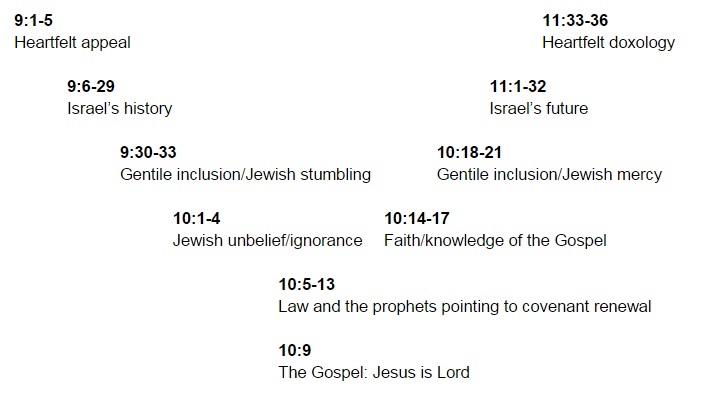
A. 중간 부분부터 살펴보겠습니다(로마서 10:1-17).
바울은 로마서 10:6-8에서 신명기 30장을 인용하면서 언약의 갱신과 유배의 종식을 묘사하는 언어를 사용하고 있습니다. “믿음에 근거한 의”(로마서 10:6)는 “믿음에 근거한 언약”(1169)을 상징합니다. 신명기 30장의 계명은 하늘이나 바다 건너편에 있는 것이 아니라, 하나님의 백성의 입과 할례 받은 마음에 있어서 그들이 순종할 수 있는 것입니다. 로마서 10장에서 바울은 말씀이 너희 입과 마음에 있다고 말합니다. 이 말씀(또는 메시지)은 복음입니다. “네가 입으로 예수가 주님이시라고 고백하고 마음으로 하나님이 그를 죽은 자 가운데서 살리셨음을 믿으면 구원을 받으리라.” (로마서 10:9) 바울은 여전히 칭의에 대해 이야기하고 있습니다. 칭의란 하나님께서 한 언약 백성의 지체로서 의롭다고 선언하시는 것(재정의된 유일신론)을 말하며(재정의된 선택), 이는 하나님께서 현재에 선포하시는 미래의 행위(재정의된 종말론)입니다. 유대인들은 자신들만의 언약 공동체 구성원 자격을 확립하려고 애썼지만(로마서 10:3), 칭의와 구원은 유대인 혈통을 가진 자들만을 위한 것이 아니라 유대인과 그리스인 모두를 위한 것이었습니다(로마서 10:12-13). 메시아이신 예수님은 율법의 종착점이시며, 믿음의 표징을 지닌 자들에게 언약 공동체 구성원 자격을 부여하셨습니다(로마서 10:4). 이스라엘의 하나님은 그의 백성의 마음을 할례하시어(신명기 30:6) "율법을 행하는 새로운 방식"을 가지시도록 하셨습니다(1173). 바울에 따르면, 이러한 새로운 방식에서 설교는 필수적입니다. 복음 전파는 유대인과 이방인의 유일하신 하나님께서 예수님 안에서 그리고 예수님을 통해 메시아이자 왕이 되셨다는 선포입니다. 이제 유대인과 이방인 모두에게 칭의뿐 아니라 구원도 주어졌습니다. 이 구절들에서 바울이 내린 결론을 염두에 두면 로마서 9장과 11장에서 이스라엘에 관해 바울이 펼치는 장황한 논증에 현혹되지 않을 수 있습니다.
B. 한 걸음 물러서서 생각해 보면 (로마서 9:30-33과 10:18-21),
바울은 로마서 9장에서 전개해 온 논지를 네 구절로 요약합니다. 하나님은 이스라엘을 택하셔서 자신의 의의 본보기로 삼으셨지만, 그들은 믿음이 아닌 율법으로 언약적 지위, 즉 의를 추구했기에 넘어졌습니다. 이러한 생각은 로마서 7장과 8장으로 우리를 이끌어 줍니다. 율법은 죄가 번성할 기회를 주었지만, 하나님은 예수 그리스도를 통해 죄를 정죄하셨습니다(로마서 8:3). 로마서 9장은 이스라엘의 택하심과 그들의 넘어짐을 묘사하지만, 죄에 대한 언급은 없습니다. 그러나 로마서 1장부터 8장까지는 죄라는 주제를 자주 다룹니다. 율법으로 맺어진 언약적 지위를 추구한 이스라엘은 결국 율법의 본래 목적, 그리고 궁극적으로 율법의 목표이신 예수 그리스도를 넘어서 넘어지게 됩니다. 로마서 9장 30-33절에 나오는 유대인들의 실수는 로마서 10장 18-21절에 묘사된 것처럼 이방인들을 질투하게 하려는 의도였습니다. 바울은 모세(로마서 10장 19절)와 이사야(로마서 10장 20절)를 인용하여 “이방인들이 이스라엘을 질투하게 하려고 들어올 것”이라고 말합니다. (1180) 이스라엘에게 주어진 소망은 하나님께서 이방인들을 언약 공동체에 포함시키셨지만, 믿음으로 언약 공동체의 일원이 된 자들에게는 여전히 자비의 손길이 향하고 있다는 것입니다(로마서 10장 21절).
C. 이스라엘의 기묘한 목적 (로마서 9:6-29)
이 부분은 부분적으로 아브라함부터 시작하는 이스라엘의 역사를 다시 이야기하는 것입니다. “사실 (제2성전 시대 유대교의) 종말론은 이런 식으로 작동합니다. 먼저 지금까지의 이스라엘 역사를 이야기하고, 그 다음에 앞으로 일어날 일을 살펴보는 것입니다.” (1181) 바울은 종말론에 대해 이야기하고 있지만, 유대교의 종말론은 역사 속에서 하나님께서 행하신 일들을 서술하는 것을 포함합니다. 어떤 의미에서는 로마서 9장을 과거에 대한 이야기, 로마서 10장을 현재에 대한 이야기, 그리고 로마서 11장을 바울이 미래에 대해 논하는 것으로 읽을 수 있습니다. 바울은 이스라엘의 역사를 그 이야기가 어디로 향하는지, 즉 이스라엘이 스스로 할 수 없었던 일을 이스라엘을 위해 행하실 메시아 예수의 도래라는 관점에서 서술하고 있습니다. 이스라엘의 하나님은 자신의 목적을 이루기 위해 역사 속에서 “자비를 베푸시기도” 하고 “마음을 완악하게 하시기도” 하셨습니다. 바울은 이스라엘의 역사를 다시 이야기하면서 하나님께서 이스라엘을 예로 들어 어떻게 사람들을 구원하시는지 일반적인 방식으로 설명하려는 것이 아닙니다. 오히려 바울은 하나님께서 이스라엘 안팎에서 행하신 일들을 묘사하고 있는 것입니다. 왜냐하면 하나님께서는 특별히 이스라엘을 통해 세상을 구원하시기로 선택하셨기 때문입니다.
이스라엘의 선택에 대한 이 이야기는 유대인의 관점에서 예수 그리스도를 믿는 이방인 신자들에게 그들이 이스라엘을 통해 이루어지는 하나님의 목적이라는 대체할 수 없는 이야기에 포함되었음을 알려주기 위한 것입니다. 바울은 하나님께서 야곱(즉, 이스라엘)에게 율법에 대한 불충실함에도 불구하고 자비를 베푸셨다는 점을 강조합니다. 하나님께서 은혜로 율법에 불충실한 백성을 택하실 수 있다면, 이처럼 “진노의 그릇”(로마서 9:22)처럼 보이는 이방인들에게도 인내를 보이실 수 있지 않겠습니까? 바울은 토기장이와 진흙의 비유를 사용하여 하나님께서 모든 인류가 아닌 이스라엘과 특별히 관계를 맺고 계심을 묘사합니다. 이스라엘은 하나님께 “당신이 우리를 특정한 방식으로 빚으시는 것은 불공평합니다!”라고 말할 수 없습니다. 하나님은 이스라엘을 택하셨고, 그분은 최고의 토기장이시며, 원하시는 대로 토기를 빚으실 수 있습니다. 이러한 선택 행위가 바로 우리가 말하는 선택입니다. “그러므로 ‘선택’이란 단순히 어떤 자들을 선택하고 어떤 자들을 버리는 것, 어떤 자들을 ‘사랑하고’ 어떤 자들을 ‘미워하는’ 것을 의미하는 것이 아닙니다. ‘선택받은 자들’은 하나님의 구원 계획이 이루어지는 장소이자 수단이 되도록 선택받은 자들입니다.” (1191)
하나님께서 마음을 완악하게 하신 행위는, 택하신 행위와 마찬가지로, 구원의 목적을 나타내기 위한 것이었습니다. 바울은 이렇게 썼습니다. “하나님께서 진노를 나타내시고 그의 능력을 나타내시려고 멸망할 진노의 그릇들을 오래 참으셨다면, 이는 미리 영광을 위해 예비하신 자비의 그릇들, 곧 유대인뿐 아니라 이방인 가운데서도 부르신 우리들을 통해 그의 영광의 풍성함을 나타내시려는 것이 아니겠습니까?” (로마서 9:22-24) 바울은 “만약에”라는 표현을 통해 이스라엘 역사에 대한 새로운 해석을 제시합니다. 만약 하나님께서 “진노의 그릇”들에게 오래 참으심을 보이시고 이방인을 포함한 “자비의 그릇”들에게 그의 풍성한 자비를 나타내심으로써 그의 심판(진노)과 능력(권위)을 나타내시려 하셨다면 어떨까요? 그 답은 바로 메시아 안에서 일어난 일이라는 것입니다. 바울은 호세아 선지자의 말씀을 인용하여 이 질문에 답합니다. “내 백성이 아니었던 자들을 내가 내 백성이라 부르고, 사랑받지 못했던 자들을 내가 사랑받는 자라 부르겠다.” (로마서 9:25, 호세아 2:23에서 인용)
D. 이스라엘의 신비로운 미래 (로마서 11:1-32)
바울은 또 다른 수사적인 질문을 던집니다. “하나님께서 자기 백성을 버리셨습니까?” 그리고 “결코 그렇지 않습니다!”라고 답합니다(로마서 11:1). 로마서 9장이 이스라엘의 역사(선택)를 다시 이야기하는 것이라면, 로마서 11장은 이스라엘의 미래(종말론)에 대한 이야기입니다. 이스라엘은 어떤 목적을 위해 겉으로는 “버려진” 것처럼 보였지만, 궁극적으로는 하나님께 받아들여지게 될 것이었습니다. 이방인을 포함시킨 것은 이스라엘의 하나님께서 자기 백성을 버리셨다는 신호가 아니라, 오히려 이스라엘 백성이 질투심을 느끼도록 하기 위함이었습니다. 이스라엘은 또한 메시아이신 예수 그리스도의 화해에 참여하도록 초대받았습니다. 바울은 이렇게 썼습니다. “그들의 버림받음이 세상의 화목을 위한 것이라면, 그들의 받아들임은 죽은 자 가운데서 살아나는 것이 아니겠습니까?”(로마서 11:15) 예수님을 주님으로 고백하는 유대 백성을 위해 언약이 새롭게 맺어졌고, 이로써 그들은 생명을 얻게 되었습니다. 그들이 “부분적으로 마음이 완악해지는 것”(로마서 11:25)을 경험하고 있는 것은 하나님께서 그들을 버리고 이방인으로 대체하셨기 때문이 아니라, 이방인이 구원받는 것에 대해 시기심을 느끼고 “온 이스라엘이 구원받을 것”이라는 생각에 사로잡히게 될까 봐 그러는 것입니다. 이스라엘은 넘어졌고(로마서 11:11), 분리되었으며(로마서 11:19), 마음이 완악해졌고(로마서 11:25), “이제 그들도 불순종하게 된 것은 너희(이방인)에게 베푸신 자비로 말미암아 그들도 이제 자비를 받게 하려 함이라”(로마서 11:31)고 말씀하셨습니다.
온 이스라엘이 구원받을까요? 바울의 대답은 언뜻 보기에 복잡해 보입니다. 로마서 11장 14절에서 바울은 “일부”가 구원받을 것이라고 예상하지만, 11장 26절에서는 온 이스라엘이 구원받을 것이라고 말합니다. 그는 분명히 말합니다. “하나님께서 모든 사람을 불순종에 내버려 두신 것은 모든 사람에게 자비를 베푸시려는 것입니다.” (로마서 11:32) 하나님의 자비는 유대인과 이방인을 가리지 않고 모든 사람에게 미치지만, 온 이스라엘이 구원받을까요, 아니면 일부만 구원받을까요? 답은 로마서 9-11장의 핵심인 로마서 10장 9-13절을 살펴보면 찾을 수 있습니다. “…네가 입으로 예수가 주님이시라고 고백하고 마음으로 하나님이 그를 죽은 자 가운데서 살리셨음을 믿으면 구원을 받으리라. 마음으로 믿어 의롭다 함을 받고 입으로 고백하여 구원을 받느니라. 성경에 이르기를 ‘그를 믿는 자는 부끄러움을 당하지 아니하리라’ 하였느니라.” 유대인이나 그리스인이나 차별이 없습니다. 같은 주님께서 만물의 주님이시며, 그분을 부르는 모든 자에게 풍성한 은혜를 베푸십니다. "주의 이름을 부르는 자는 누구든지 구원을 받을 것이다." 이 점에서 유대인도 자랑할 수 없고 이방인도 자랑할 수 없습니다. 이방인들은 접붙여졌고, 유대인들이 끊어졌다 하더라도 하나님께서는 다시 접붙이실 능력이 있으십니다. 이스라엘의 구원은 이방 민족의 구원과 동일하며, 예수 그리스도를 믿는 믿음으로 추구하는 언약적 지위 안에 있습니다.
E. 시작과 끝 (로마서 9:1-5 및 로마서 11:33-36)
이 부분은 많은 시편과 마찬가지로 애가로 시작하여 찬양으로 끝맺습니다. 바울은 이렇게 시작합니다. “내 마음에는 큰 슬픔과 끊임없는 고통이 있습니다. 내 형제들, 곧 육신으로 내 친척인 사람들을 위하여 내가 그리스도에게서 끊어져 저주받기라도 할 수 있기를 바랍니다.” (로마서 9:2-3) 그리고 이렇게 마무리합니다. “모든 것이 그분에게서 나오고 그분을 통하여 있고 그분께로 돌아갑니다. 그분께 영광이 영원토록 있기를 바랍니다. 아멘.” (로마서 11:36) “바울은 다시 한번 자신이 가장 잘하는 일을 하고 있습니다. 즉, 고대 이스라엘의 신앙을 예수님과 성령을 중심으로 재해석하고 새롭게 그려내어 모든 생각을 사로잡아 메시아께 순종하게 하는 것입니다.” (1256)
III. 바울 신학 요약
바울은 세 가지 유대교 패러다임, 즉 유일신론, 선택론, 종말론을 예수 그리스도와 성령의 오심에 비추어 철저히 재해석했습니다. 그렇게 함으로써 그는 유대 율법을 본래 의도했던 종결점으로 가져옴으로써 이스라엘의 소망을 변화시켰습니다. 언약은 약속대로 새롭게 되었습니다. 여호와께서는 언약에 신실하시어 메시아를 믿는 그의 백성에게 돌아오셨습니다. 이제 그의 영은 숨 쉬는 돌로 지어진, 재건된 성전에 거하십니다. 그의 마지막 심판은 메시아의 몸 안에 있는 자들에게 경험되었습니다. 유대인과 이방인 모두 의롭다 하심을 선언받았고, 따라서 하나님의 언약 가족의 구성원이 되었습니다. 하나님께서 세상을 축복하고 구원하고 치유하시는 사역이 시작되었지만 아직 끝나지 않았습니다. 하나님은 아브라함에게 하신 약속에 신실하셨고, 그 신실함은 예수 그리스도를 통해 드러났습니다.
IV. 결론
복음은 유대인을 위한 것이기도 하지만, 그리스인, 이방인, 비유대인을 위한 것이기도 합니다. 복음은 유대인들이 예배하는 하나님께서 어떻게 세상의 왕이 되셨는지를 선포합니다. 이스라엘과 이방 민족의 미래는 그들이 복음에 어떻게 반응하느냐에 달려 있습니다.
Pastor | Teacher | Author
I am blogging my way through N.T. Wright’s Paul and the Faithfulness of God, creating an outline of the book as a part of a class I am teaching at our church. This is the eighth of a nine-part series. All quotations followed by a number in parenthesis are quotes from the book. Check out the previous posts here: Part 1 | Part 2 | Part 3 | Part 4 | Part 5 | Part 6 | Part 7
Part 8: Eschatology and Romans 9-11
Paul and the Faithfulness of God, Chapter 11, Sections 6.4 – 7
I. Approaching Difficult Terrain
“It is easy to be overwhelmed by Romans 9-11: its scale and scope, the mass of secondary literature, the controversial theological and also political topics, and the huge and difficult questions of the overall flow of thought on the one hand and the complex details of exegesis and interpretation on the other.” (1156) We approach Romans 9-11 admitting the difficulty of the challenge before us. Those who say Romans 9-11 is easy to understand and easily applied to our lives haven’t taken the time to seriously read these 90 verses. N.T. Wright discusses this section in the context of eschatology, but these three chapters are connected to monotheism and election, and belong to the rest of the book. They are “bound into the letter’s whole structure by a thousand silken strands.” (1157)
Romans 9 is filled with questions related to God’s future purposes. This chapter is a retelling of Israel’s story from God’s election of them for a specific job to the exodus event with Moses and Pharaoh, including some comments from the prophets. This section (Romans 9-11) follows logically from where Paul leaves off in Romans 8, where he has discussed the life and love experienced by those who are in the Messiah. Romans 9 deals with those who have not believed, primarily those of Israel who have not believed in Jesus the Messiah.
II. Artistic Structure of Romans 9-11
One of the most helpful tools in understanding this section is to see the structure and counter balance of the ideas presented with the central thought found in Romans 10:9.
A. Starting in the middle (Romans 10:1-17)
In quoting from Deuteronomy 30 in Romans 10:6-8, Paul is using language to describe the renewal of the covenant and the end of exile. The “righteousness based on faith” (Romans 10:6) is picture of the “faith-based covenant” (1169). In Deuteronomy 30 it is a commandment which is not in heaven or beyond in the sea, but in the mouth and circumcised heart of God’s people so they can obey. In Romans 10, Paul says the word is in your mouth and heart. This word (or message) is the Gospel: “ if you confess with your mouth that Jesus is Lord and believe in your heart that God raised him from the dead, you will be saved.” (Romans 10:9) Paul is still talking about justification, that is the one God’s declaration (redefined monotheism) of those who are in the right as members of the one covenant people (redefined election), a future act God is declaring in the present (redefined eschatology). The Jewish people were seeking to establish their own covenant membership (Romans 10:3), but justification and salvation were not only for those with Jewish ethnicity, but for both Jew and Greek alike (Romans 10:12-13). Jesus the Messiah is the end, the termination point, of the torah making covenant membership available to those who wear the badge of faith (Romans 10:4). The God of Israel intended on circumcising the hearts of his people (Deuteronomy 30:6) so there would be a “new way of doing the law” (1173). According to Paul, preaching becomes necessary in this new way. Preaching the Gospel is the announcement that the one God of Jews and Gentiles has become Messiah and King in and through Jesus. Salvation, in addition to justification, is now available for Jews and Gentiles. Keeping Paul’s conclusions in these verses in mind can prevent us from getting lost in Paul’s longer arguments regarding Israel in Romans 9 and 11.
B. Taking a step back (Romans 9:30-33 and 10:18-21)
Paul sums up in four verses the case he has been building in Romans 9, God choose Israel to be examples of his righteousness, but they have stumbled because they pursued righteousness, that is a covenant status, not by faith, but by the torah. This line of thinking takes us further back to Romans 7 and 8. The torah gives sin an opportunity to spread, but God condemns sin in the flesh of Jesus the Messiah (Romans 8:3). Romans 9 describes the election of Israel and their stumbling, but there is no mention of sin, although Roman 1-8 deals often with the topic if sin. In pursuing a covenant status formed by the torah, Israel ends up stumbling over the very intent of the law and ultimately the goal of the torah, Jesus the Messiah. The Jewish stumbling in Romans 9:30-33 intended to make the Gentiles jealous as described in Romans 10:18-21. Paul draws upon Moses (Romans 10:19) and Isaiah (Romans 10:20) as witnesses to the fact that “Gentiles were going to be brought in to make Israel jealous.” (1180) The hope for Israel is while God has included Gentiles in the covenant family, those who have pursued covenant membership by faith, God still holds out his hands of mercy towards Israel (Romans 10:21).
C. Israel’s Strange Purpose (Romans 9:6-29)
This section is, in part, a retelling of the story of Israel beginning with Abraham. “This, in fact, is how (second-temple Jewish) eschatology works: first you tell the story of Israel so far, and then you look on to what is still to come.” (1181) Paul is talking about eschatology, but Jewish eschatology includes a recounting of God’s activity in history. In one sense, we could read Romans 9 as speaking of the past, Romans 10 dealing with the present, and Romans 11 as Paul’s discussion of the future. Paul is recounting Israel’s story in light of where that story goes namely to the coming of Jesus the Messiah who does for Israel what Israel could not do for herself. The God of Israel has been active in history “showing mercy” and “hardening” in order to fulfill his purposes. Paul is not retelling Israel’s history to demonstrate how God saves people in general using Israel as an example. Rather Paul is describing God’s action in and surrounding Israel, because it is in and through Israel in particular that God has chosen to save the world.
This retelling of Israel’s election is told from a Jewish point of view to point out to Gentile believers in Jesus the Messiah that they have been included in a irreplaceable story of God’s purposes in and through Israel. Paul’s emphasis is God has shown mercy to Jacob (i.e Israel) a part from Israel’s lack of commitment to the torah. If God can by his grace choose a people unfaithful to the torah then what if God has chosen to be patient with Gentiles these seemingly “vessels of wrath” (Romans 9:22)? Paul uses the metaphor of a potter and clay to describe his dealings specifically with Israel and not all humanity. Israel cannot tell God: “You are unfair in molding us in a certain way!” God has chosen Israel and he is the master potter and can mold pottery in any way he chooses. This act of choosing is what we mean by election. “It is not, then, that ‘election’ simply involves a selection of some and a leaving of others, a ‘loving’ of some and a ‘hating’ of others. It is that the ‘elect’ themselves are elect in order to be the place where and the means by which God’s redemptive purposes are worked out.” (1191)
God’s act of hardening, like his act of electing, was to demonstrate his saving purposes. Paul writes: “What if God, desiring to show his wrath and to make known his power, has endured with much patience vessels of wrath prepared for destruction, in order to make known the riches of his glory for vessels of mercy, which he has prepared beforehand for glory— even us whom he has called, not from the Jews only but also from the Gentiles?” (Romans 9:22-24). By writing “what if” Paul is introducing a new interpretation to Israel’s story. What if God wanted to demonstrate his judgment (wrath) and power (authority) by showing patience towards “vessels of wrath” and revealing the richness of his mercy in his “vessels of mercy” which includes Gentiles? The answer is: this is exactly what has happened in Messiah. Paul quotes from the prophet Hosea to answer the question: “Those who were not my people I will call ‘my people,’ and her who was not beloved I will call ‘beloved’” (Romans 9:25, quoted from Hosea 2:23).
D. Israel’s Mysterious Future (Romans 11:1-32)
Paul asks another rhetorical question: “Has God rejected his people?” He answers: “By no means!” (Romans 11:1) If Romans 9 is a retelling of Israel’s history (election) then the counter-balance is an account of Israel’s future in Roman 11 (eschatology). Israel has been seemingly “cast away” for a purpose, that would ultimately lead to their acceptance. The inclusion of Gentiles was not a sign indicating the God of Israel has rejected his people, rather it was to make Israel jealous. Israel is also invited to participate in the reconciliation of Jesus the Messiah. Paul writes, “For if their rejection [casting away] means the reconciliation of the world, what will their acceptance mean but life from the dead?” (Romans 11:15) The covenant is renewed for the Jewish people who confess Jesus is Lord which makes them alive. They are experiencing a “partial hardening” (Romans 11:25), not because God has rejected them and replaced them with Gentiles, but that they would become jealous by the Gentile inclusion and “all Israel will be saved.” Israel stumbled (Romans 11:11), was broken off (Romans 11:19), was hardened (Romans 11:25), and “they too have now been disobedient in order that by the mercy shown to you (Gentiles) they also may now receive mercy” (Romans 11:31).
Will all Israel be saved? Paul’s answer is, at first glance, complex. In Romans 11:14 Paul expects “some” to be saved, but in Romans 11:26 he says all Israel will be saved. He is clear: “God has consigned all to disobedience, that he may have mercy on all.” (Romans 11:32) God’s mercy extends to all, Jew and Gentile alike, but will all Israel be saved or just some? The answer is found in looking back at the rhetorical center of Romans 9-11, which is Romans 10:9-13: “..If you confess with your mouth that Jesus is Lord and believe in your heart that God raised him from the dead, you will be saved. For with the heart one believes and is justified, and with the mouth one confesses and is saved. For the Scripture says, ‘Everyone who believes in him will not be put to shame.’ For there is no distinction between Jew and Greek; for the same Lord is Lord of all, bestowing his riches on all who call on him. For “everyone who calls on the name of the Lord will be saved.” In this regard, Jews cannot boast and neither can Gentiles. Gentiles have been grafted in and if Jews have been broken off, God has the power to graft them in again. Salvation for Israel is the same as salvation for the Gentile nations; it is found in a covenant status pursued by faith in Jesus the Messiah.
E. The Beginning and the End (Romans 9:1-5 and Romans 11:33-36)
This section follows the pattern of many of the Psalms, by opening with a lament and closing with praise. Pauls opens with: “I have great sorrow and unceasing anguish in my heart. For I could wish that I myself were accursed and cut off from Christ for the sake of my brothers, my kinsmen according to the flesh.” (Romans 9:2-3) He closes this section with: “For from him and through him and to him are all things. To him be glory forever. Amen.” (Romans 11:36). “Paul is doing again what he does best: expounding the ancient faith of Israel, rethought and reimagined around Jesus and the spirit, in such a way as to take every thought captive to obey the Messiah.” (1256)
III. Summing Up Paul’s Theology
Paul has taken three Jewish paradigms—monotheism, election, and eschatology—and thoroughly reworked them in light of Jesus the Messiah and the coming of the Spirit. In doing so he has transformed the hope of Israel by bringing the Jewish law to its intended termination point. The covenant has been renewed as promised. Yahweh has been faithful to the covenant and has returned to his people who are marked by faith in the Messiah. His Spirit now dwells in his rebuilt temple, that temple made with stones that breathe. His final act of judgment has been experienced by those in the body of Messiah. Both Jews and Gentiles have been declared in the right and thus members of God’s covenant family. Gods action of blessing, saving, and healing God’s world has begun, but it is not complete. God has been faithful to his promise to Abraham, a faithfulness to the covenant that has been displayed by the faithfulness of Jesus the Messiah.
IV. Final Thoughts
The Gospel is for the Jew first and also for the Greek, the Gentile, the non-Jew. The Gospel declares how the God worshiped by the Jews has become the King of the world. The future for Israel and Gentile nations depends on how they respond to the Gospel.
출처: 정태홍 목사의 성경적 상담 연구소 RBD COUNSELING INSTITUTE · 현대신학자료2
https://www.esesang91.com/b/kkkexchan102/17