Jesus in the Talmud 2
Jesus in the Talmud 2
http://en.wikipedia.org/wiki/Jesus_in_the_Talmud#Notes
Torah teacher Scholars have identified passages that mention Jesus, as the messiah of Christianity, in the context of a Torah teacher:[78]
According to Dr. Rubenstein, the account in Sanhedrin 107b recognizes the kinship between Christians and Jews, since Jesus is presented as a disciple of a prominent Rabbi. But it also reflects and speaks to an anxiety fundamental to Rabbinic Judaism. Prior to the destruction of the Temple in 70, Jews were divided into different sects, each promoting different interpretations of the law. Rabbinic Judaism domesticated and internalized conflicts over the law, while vigorously condemning any sectarianism. In other words, rabbis are encouraged to disagree and argue with one another, but these activities must be carefully contained, or else they could lead to a schism. Although this story may not present a historically accurate account of Jesus' life, it does use a fiction about Jesus to communicate an important truth about the Rabbis. Moreover, Rubenstein sees this story as a rebuke to overly harsh Rabbis. Boyarin suggests that the Rabbis were well aware of Christian views of the Pharisees and that this story acknowledges the Christian belief that Jesus was forgiving and the Pharisees were not (see Mark 2:1–2), while emphasizing forgiveness as a necessary Rabbinic value.[28]
In the Florence manuscript of the Talmud (1177 CE) an addition is made to Sanhedrin 43a saying that Yeshu was hanged on the eve of the Sabbath.[88]
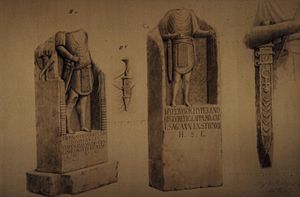
 Tombstone of Tiberius Iulius Abdes Pantera, a soldier who has been claimed to be the "Pantera" named by Talmud.Some Talmudic sources include passages which identify a "son of Pandera" ("ben Pandera" in Hebrew), and some scholars conclude that these are references to the messiah of Christianity[89] However, other scholars conclude that the "son of Pandera" mentioned in these contexts is another person, not the messiah of Christianity.[citation needed]
The Talmud, and other talmudic texts, contain several references to the "son of Pandera". A few of the references explicitly name Jesus ("Yeshu") as the "son of Pandera": these explicit connections are found in the Tosefta, the Qohelet Rabbah, and the Jerusalem Talmud, but not in the Babylonian Talmud.[90] The explicit connections found in the Jerusalem Talmud are debated because the name "Jesus" ("Yeshu") is found only in a marginal gloss in some manuscripts, but other scholars conclude that it was in the original versions of the Jerusalem Talmud.[91]
The texts include several spellings for the father's name (Pandera, Panthera, Pandira, Pantiri, or Pantera) and some scholars conclude that these are all references to the same individual,[92] but other scholars suggest that they may be unrelated references.[93] In some of the texts, the father produced a son with a woman named Mary (Miriam in Hebrew). Several of the texts indicate that the mother was not married to Pandera, and was committing adultery and – by implication – Jesus was a bastard child.[92] Some of the texts indicate that Mary's husband's name was Stada.
Some Talmudic sources include passages which identify a "son of Stada" or "son of Stara" ("ben Stada" or "ben Stara" in Hebrew), and some some scholars conclude that these are references to the messiah of Christianity.[94]
The Toledot Yeshu (History of Jesus) is a Jewish anti-Christian polemic that purports to be a biography of Jesus.[100] Some scholars conclude that the Toldeot Yeshu is an expansion and elaboration on anti-Christian themes in the Talmud.[101] Stephen Gero suggests that an early version of the Toledot Yeshu narrative preceded the Talmud, and that the Talmud drew upon the Toledot Yeshu, but Rubenstein and Schäfer discount that possibility, because they date the origin of the Toledot Yeshu in the early Middle Ages or Late Antiquity.[102]
http://en.wikipedia.org/wiki/Jesus_in_the_Talmud#Notes
Torah teacher Scholars have identified passages that mention Jesus, as the messiah of Christianity, in the context of a Torah teacher:[78]
- Babylonian Abodah Zarah 17a – "One of the disciples of Jesus the Nazarene found me" (Editions or MSs: Munich 95, Paris 1377, New York 15)
- Tosefta Hullin 2:24 – "He told me of a word of heresy in the name of Jesus son of Pantiri"
- Qohelet Rabbah 1:8(3) – "He told me a word in the name of Jesus son of Pandera" (Editions or MSs: Oxford 164, Vatican 291, Pesaro 1519)
- Babylonian Abodah Zarah 17a – "Thus I was taught by Jesus the Nazarene" (Editions or MSs: Munich 95, Paris 1337)
[edit] The son or disciple who turned out badly
Sanhedrin 103a and Berachot 17b talk about a Yeshu ha-Nosri (Jesus of Nazareth) who "burns his food in public", possibly a reference to pagan sacrifices or a metaphor for apostasy.[81] The account is discussing Manasseh the king of Judah infamous for having turned to idolatry and having persecuted the Jews (2 Kings 21). It is part of a larger discussion about three kings and four commoners excluded from paradise. These are also discussed in the Shulkhan Arukh where the son who burns his food is explicitly stated to be Manasseh. The passages identified by scholars in this context are:[78]- Babylonian Sanhedrin 103a – "that you will not have a son or disciple ... like Jesus the Nazarene" (Editions or MSs: Firenze II.1.8–9, Barco, Munich 95)
- Babylonian Berakoth 17b – "that we will not have a son or disciple ... like Jesus the Nazarene" (Editions or MS: Oxford 23)
[edit] As a sinful student who practiced magic and turned to idolatry
Passages in Sanhedrin 107b and Sotah 47a refer to an individual that some scholars conclude is a reference to Jesus, regarded as the messiah of Christianity. In these passages, Jesus is described as a student of Yehoshua ben Perachya (second half of the 2nd century), and he (Jesus) was sent away for misinterpreting a word that in context should have been understood as referring to the Inn; he instead understood it to mean the innkeeper's wife (the same word can mean "inn" and "hostess").[82] His teacher said "Here is a nice inn", to which he replied "Her eyes are crooked", to which his teacher responded "Evil one! Is this what you are occupied in?" (Gazing at women was considered sinful.) [83] After several returns for forgiveness he mistook Perachiah's signal to wait a moment as a signal of final rejection, and so he turned to idolatry. Some passages that have been identified by scholars as mentioning Jesus, as the messiah of Christianity, in this context include:[84]- Babylonian Sanhedrin 107b – "not as Yehoshua b. Perahya who pushed Jesus the Nazarene away" (Editions or MSs: Barco, Vilna)
- Babylonian Sotah 47a – "not as Yehoshua b. Perahya who pushed Jesus the Nazarene away" (Editions or MSs: Vatican 110, Vilna, Munich 95)
- Babyonian Sanhedrin 107b – "Jesus said to him: Rabbi, her eyes are narrow" (Editions or MSs: Herzog 1)
- Babylonian Sotah 47a – "Jesus the Nazarene said to him: Rabbi, here eyes are narrow" (Editions or MS: Oxford 20)
- Babylonian Sanhedrin 107b – "The master said: Jesus the Nazarene practiced magic (Editions or MSs: Firenze II.1.8–9, Barco )
- Babylonian Sotah 47a – "The master said: Jesus the Nazarene because he practiced magic" (Editions or MS: Munich 95)
The story ends by invoking a Mishnaic era teaching that Yeshu practised black magic, deceived and led Israel astray. This quote is seen by some as an explanation in general for the designation Yeshu.In all circumstances (one should exercise) use the left hand to push (away) and the right (to) bring closeward ..not like Yehoshua ben Perachya who pushed him –to Yeshu- with both hands.. (here the Talmud begins a narration) at the time that Yannai the king was executing the Rabbis, Shimon ben Shatach(‘s sister) hid Rabbi Yehoshua ben Perachya, he (then, subsequently was able to) go and run (escape) to Alexandira of Egypt. When there was (came) and (an era of) peace, Shimon ben Shatach sent to him (a letter:) “from me Yerushalayim the holy city to you Alexander of Egypt -my sister, my husband dwells amongst you and I am sitting lonely” said (Rabbi Yeshushua ben Perachya) “I deduce (from the letter) that he (is enjoying)peace. As he (Rabbi Yehoshua ben Perachya) came they went up to a lodge, (they -at the lodge) stood for him with exemplary honor and did for him extended goodness. He sat and was in the midst of praising 'how beautiful is this lodging', (Yeshu) said to him “My master, her eyes are misshaped”. He said to him “Evil one!, in this you are busy with?!” he brought out four hundred Shofars and excommunicated him. Every day he would come before him (intent on being readmitted,) and he did not accept him. One day he was reciting Kriat Shema,[85] he (Yeshu) came before him (the Rabbi) -it was on his (the Rabbi's) mind to accept him- he (the Rabbi) showed him with his hand, he (Yeshu) thought 'push he is pushing him', (Yeshu then) went erected a fish worship, he (his Rabbi) said to him 'return yourself' he (Yeshu) said to him '(so) I learnt from you; 'all who sin and cause others to sin we do not give (are not given) him the ability to repent'.—Sotah 47a, Sanhedrin 107
According to Dr. Rubenstein, the account in Sanhedrin 107b recognizes the kinship between Christians and Jews, since Jesus is presented as a disciple of a prominent Rabbi. But it also reflects and speaks to an anxiety fundamental to Rabbinic Judaism. Prior to the destruction of the Temple in 70, Jews were divided into different sects, each promoting different interpretations of the law. Rabbinic Judaism domesticated and internalized conflicts over the law, while vigorously condemning any sectarianism. In other words, rabbis are encouraged to disagree and argue with one another, but these activities must be carefully contained, or else they could lead to a schism. Although this story may not present a historically accurate account of Jesus' life, it does use a fiction about Jesus to communicate an important truth about the Rabbis. Moreover, Rubenstein sees this story as a rebuke to overly harsh Rabbis. Boyarin suggests that the Rabbis were well aware of Christian views of the Pharisees and that this story acknowledges the Christian belief that Jesus was forgiving and the Pharisees were not (see Mark 2:1–2), while emphasizing forgiveness as a necessary Rabbinic value.[28]
[edit] Punishment in hell
In Gittin 56b, 57a a story is mentioned in which Onkelos -intent on converting to Judaism- summons up the spirit of Yeshu. He describes his punishment in the afterlife as boiling in excrement. Relevant passages from the Talmud that scholars address in this context include:[86]- Babylonin Gittin 57a – "he went and brought up Jesus the Nazarene" (Editions or MSs: Vatican 130)
Onkelos son of Kolonikos ... went and raised Titus from the dead by magical arts, and asked him; 'Who is most in repute in the [other] world? He replied: Israel. What then, he said, about joining them? He said: Their observances are burdensome and you will not be able to carry them out. Go and attack them in that world and you will be at the top as it is written, Her adversaries are become the head etc.; whoever harasses Israel becomes head. He asked him: What is your punishment [in the other world]? He replied: What I decreed for myself. Every day my ashes are collected and sentence is passed on me and I am burnt and my ashes are scattered over the seven seas. He then went and raised Balaam by incantations. He asked him: Who is in repute in the other world? He replied: Israel. What then, he said, about joining them? He replied: Thou shalt not seek their peace nor their prosperity all thy days for ever. He then asked: What is your punishment? He replied: With boiling hot semen. He then went and raised by incantations Jesus [in Vilna edition: "the sinners of Israel"; "Jesus" appears in Munich 95 and Vatican 130, 140 manuscripts]. He asked them: Who is in repute in the other world? They replied: Israel. What about joining them? They replied: Seek their welfare, seek not their harm. Whoever touches them touches the apple of his eye. He said: What is your punishment? They replied: With boiling hot excrement, since a Master has said: Whoever mocks at the words of the Sages is punished with boiling hot excrement. Observe the difference between the sinners of Israel and the prophets of the other nations who worship idols. It has been taught: Note from this incident how serious a thing it is to put a man to shame, for God espoused the cause of Bar Kamza and destroyed His House and burnt His Temple.—Babylonian Talmud, Gittin 56b-57a
[edit] Execution
Scholars have identified passages that mention Jesus in the context of his execution:- Babylonian Sanhedrin 43a-b -"on the eve of Passover they hanged Jesus the Nazarene" (Editions or MSs: Herzog 1, Karlsruhe 2)
- Babylonian Sanhedrin 43a-b – "Jesus the Nazarene is going forth to be stoned" (Editions or MSs: Herzog 1, Firenze II.1.8–9, Karlsruhe 2)
- Babylonian Sanhedrin 43a-b – "Do you suppose Jesus the Nazarene was one for whom a defense could be made?" (Editions or MSs: Herzog 1, Firenze II.1.8–9, Karlsruhe 2 )
- Babylonian Sanhedrin 43a-b – "With Jesus the Nazarene it was different" (Editions or MSs: Herzog 1, Firenze II.1.8–9, Karlsruhe 2)
In the Florence manuscript of the Talmud (1177 CE) an addition is made to Sanhedrin 43a saying that Yeshu was hanged on the eve of the Sabbath.[88]
[edit] Mother and father

The Talmud, and other talmudic texts, contain several references to the "son of Pandera". A few of the references explicitly name Jesus ("Yeshu") as the "son of Pandera": these explicit connections are found in the Tosefta, the Qohelet Rabbah, and the Jerusalem Talmud, but not in the Babylonian Talmud.[90] The explicit connections found in the Jerusalem Talmud are debated because the name "Jesus" ("Yeshu") is found only in a marginal gloss in some manuscripts, but other scholars conclude that it was in the original versions of the Jerusalem Talmud.[91]
The texts include several spellings for the father's name (Pandera, Panthera, Pandira, Pantiri, or Pantera) and some scholars conclude that these are all references to the same individual,[92] but other scholars suggest that they may be unrelated references.[93] In some of the texts, the father produced a son with a woman named Mary (Miriam in Hebrew). Several of the texts indicate that the mother was not married to Pandera, and was committing adultery and – by implication – Jesus was a bastard child.[92] Some of the texts indicate that Mary's husband's name was Stada.
Some Talmudic sources include passages which identify a "son of Stada" or "son of Stara" ("ben Stada" or "ben Stara" in Hebrew), and some some scholars conclude that these are references to the messiah of Christianity.[94]
[edit] Son of Pantera / Pandera in a healing context
Two talmudic-era texts that explicitly associate Jesus as the son of Pantera/Pandera are:- Tosefta Hullin 2:22f "Jacob ... came to heal him in the name of Jesus son of Pantera"
- Qohelet Rabbah 1:8(3) "Jacob ... came to heal him in the name of Jesus son of Pandera"
- Jerusalem Abodah Zarah 2:2/7 "someone ... whispered to him in the name of Jesus son of Pandera"
- Jerusalem Shabboth 14:4/8 "someone ... whispered to him in the name of Jesus son of Pandera"
- Jerusalem Abodah Zarah 2:2/12 "Jacob ... came to heal him. He said to him: we will speak to you in the name of Jesus son of Pandera"
- Jerusalem Shabboth 14:4/13 "Jacob ... came in the name of Jesus Pandera to heal him"
[edit] Son of Pantiri / Pandera in a teaching context
Other Talmudic narratives describe Jesus as the son of a Pantiri or Pandera, in a teaching context:[97]- Tosefta Hullin 2:24 "He told me of a word of heresy in the name of Jesus son of Pantiri"
- Qohelet Rabbah 1:8(3) "He told me a word in the name of Jesus son of Pandera"
- Babylonian Abodah Zarah 17a "One of the disciples of Jesus the Nazarene found me"
- Babylonian Abodah Zarah 17a "Thus I was taught by Jesus the Nazarene"
[edit] Pandera and alleged adultery by Mary
The Babylonian talmud contains narratives that discuss an anonymous person who brought witchcraft out of Egypt, and the person is identified as "son of Pandera" or "son of Stada". The Talmud discusses whether the individual (the name Jesus is not present in these passages) is the son of Stada, or Pandera, and a suggestion is made that the mother Mary ("Miriam" in Hebrew) committed adultery.[90]- Babylonian Shabbat 104b "Was he the son of Stara (and not) the son of Pandera?" (Editions or MSs: Oxford 23, Soncino)
- Babylonian Sanhedrin 67a "Was he the son of Stara (and not) the son of Pandera?" (Editions or MSs: Herzog 1, Karlsruhe 2, ... )
- Babylonian Shabbat 104b "husband Stada, lover Pandera" (Editions or MSs: Vatican 108, Munich 95, Vilna )
- Babylonian Sanhedrin 67a "husband Stara, lover Pandera" (Editions or MSs: Herzog 1, Barco)
- Babylonian Shabbat 104b "husband Pappos, mother Stada" (Editions or MSs: Vilna, Munich 95 )
- Babylonian Sanhedrin 67a "husband Pappos, mother Stada" (Editions or MSs: Vilna, Munich 95)
- Babylonian Shabbat 104b "his mother Miriam who let grow (her) women's hair" (Editions or MSs: Vilna, Oxford 23, Soncino)
- Babylonian Sanhedrin 67a "his mother Miriam who let grow (her) women's hair" (Editions or MSs: Karlsruhe 2, Munich 95)
[edit] Mary as the mother
There is no Talmudic text that directly associates Jesus with Mary (Miriam), instead the association is indirect: Jesus is associated with a father ("son of Pandera"), and in other passages, Pandera is associated with Mary (as her lover).[98][edit] Christians
Aside from mentions of the five disciples of "Yeshu ha Notzri," the actual Notzrim, "Christians," are only clearly mentioned once in the Babylonian Talmud, (where it is amended to Netzarim, people of the watch).[99][edit] Relation to the Toledot Yeshu
 |
This section requires expansion. |
[edit] Related narrative from Celsus
The Platonistic philosopher Celsus, writing circa 150 to 200 CE, wrote a narrative describing a Jew who discounts the story of the Virgin Birth of Jesus.[103] Scholars have remarked on the parallels (adultery, father's name "Panthera", return from Egypt, magical powers) between Celsus' account and the Talmudic narratives.[98] In Celsus' account, the Jew says:". . .[Jesus] came from a Jewish village and from a poor country woman who earned her living by spinning. He says that she was driven out by her husband, who was a carpenter by trade, as she was convicted of adultery. Then he says that after she had been driven out by her husband and while she was wandering about in a disgraceful way she secretly gave birth to Jesus. He states that because he [Jesus] was poor he hired himself out as a workman in Egypt, and there tried his hand at certain magical powers on which the Egyptians pride themselves; he returned full of conceit, because of these powers, and on account of them gave himself the title of God . . . the mother of Jesus is described as having been turned out by the carpenter who was betrothed to her, as she had been convicted of adultery and had a child by a certain soldier named Panthera."[104][105]
[edit] See also
- Benjamin Urrutia
- Criticism of the Talmud
- Gamaliel
- Historicity of Jesus
- Judaism and Christianity
- Judaism's view of Jesus
- The Talmud Unmasked
- Toledot Yeshu
- Yeshu
- Birkat haMinim
[edit] Bibliography
- Boyarin, Daniel: Dying for God, Stanford University Press, 1999
- Carroll, James, Constantine's sword: the church and the Jews : a history, Houghton Mifflin Harcourt, 2002
- Cohn-Sherbok, Dan, Judaism and other faiths, Palgrave Macmillan, 1994
- Dalman, Gustav: Jesus Christ in the Talmud, Midrash, Zohar, and the Liturgy of the Synagogue, Deighton, Bell, and Co., 1893
- Eisenmenger, Johann Andreas. Entdecktes Judenthum, 1711. English translations: 1732–34 by J.P. Stekelin "The Traditions of the Jews, with the Expositions and Doctrines of the Rabbins,"; English translation re-published in 2006 as "The traditions of the Jews", by Independent History & Research. German edition online here.
- Goldstein, Morris, Jesus in the Jewish Tradition, Macmillan, 1950
- Herford, R. Travers, Christianity in Talmud and Midrash, London: Williams & Norgate, 1903 (reprint New York, KTAV, 1975)
- Hirshman , Mark, A Rivalry of Genius: Jewish and Christian Biblical Interpretation in Late Antiquity trans. Baya Stein. Albany: SUNY Press 1996
- Klausner, Joseph, Yeshu ha-Notzri (Hebrew), Shtible, 1922. Translated and reprinted as Jesus of Nazareth, Beacon Books, 1964; translated and reprinted as Jesus of Nazareth, Bloch, 1989
- Krauss, Samuel, Das Leben Jesu nach judischen Quellen, Berlin: S. Calvary, 1902
- Laible, Heinrich, Jesus Christus im Thalmud (Jesus Christ in the Talmud), 1893. English translation published 2010 by General Books
- Daniel J. Lasker, 2007, Ben-Gurion University of the Negev, Israel ""Introduction to 2006 Reprint Edition", of Christianity in Talmud and Midrash, by R. Travers Herford, KTAV Publishing House, Inc., 2007
- Lauterbach, Jacob Z., "Jesus in the Talmud” in Rabbinic Essays, Cincinnati: Hebrew Union College Press, 1951 (reprinted by Ktav, 1973).
- Johann Maier, Jesus von Nazareth in der talmudischen Uberlieferung, Buchgesellschaft, 1978.
- Neusner, Jacob, Judaism in the Matrix of Christianity Philadelphia: Fortress Press 1986
- Pick, Bernhard, The Talmud: what it is and what it says about Jesus and the Christians, 1887 (reprinted Kessinger Publishing, 2007)
- Rubenstein, Jeffrey, Stories of the Babylonian Talmud (cited as "Rubenstein SBT"), JHU Press, 2010
- Rubenstein, Jeffrey, Rabbinic Stories (cited as "Rubenstein"), New York: The Paulist Press, 2002
- Schäefer, Peter, Jesus in the Talmud, Princeton University Press, 2007
- Seidman, Naomi, Faithful renderings: Jewish-Christian difference and the politics of translation, University of Chicago Press, 2006
- Strack, Hermann: Jesus, die Haretiker und die Christen nach den altesten judischen Angaben, Leipzig: J. C. Hinrichs'sche Buchhandlung, 1910
- Theissen, Gerd, Annette Merz, The historical Jesus: a comprehensive guide, Fortress Press, 1998
- Van Voorst, Robert E.: Jesus outside the New Testament, Wm. B. Eerdmans Publishing, 2000
독자 의견
댓글이 없습니다.